EBD-Newsletter December 2025 | The Year 2026 Will Determine Europe’s Strength
Dear readers,
2025 was no ordinary year - it was a wake-up call. The new U.S. national security doctrine should open our eyes: we can no longer take the transatlantic partnership for granted. It is not only authoritarian regimes that seek to undermine liberal democracy in Europe; now even the United States, a NATO ally, is contributing to this pressure. In 2026, the free nations of Europe will have to close ranks - in security, foreign, and economic policy. Despite attempts to destabilize it from outside and within, the EU remains a resilient community founded on the rule of law.
Following the federal election on 23 February 2025, the German government now has the opportunity to strengthen Europe both politically and operationally. Elevating EU policy to the level of a top governmental priority, reinforcing the Chancellery’s European coordination structures, and streamlining decision-making processes were important first steps. What matters now is a coherent, robust cross-government strategy: fewer silos, fewer “German votes” (i.e., last-minute abstentions or blocking positions), more Team Europe - and a tone that explains rather than lectures.
Security remains at the core. Ukraine is defending not only its territorial integrity but also values fundamental to European sovereignty. As an EU candidate country, it illustrates that enlargement is a lever against corruption and for democratic stability. Despite some progress, the pace of the promised enlargement has fallen short of expectations; at the same time, a growing Union requires institutional reform - more qualified-majority voting, clearer procedures, greater reliability. Authoritarian governments in Serbia and Turkey call for principled firmness - without weakening the democratic forces on the ground.
But this is about more than just EU enlargement. A free Europe needs impulses that reach beyond the EU itself. Our joint AA/EBD Council of Europe conference on 8 July demonstrated how closely the EU and the Council of Europe must cooperate when democracy, the rule of law, and societal resilience are at stake.
2026 should be the year in which we bring together our central projects: a credible European security architecture, a liberal and democratic market economy, a trustworthy enlargement policy, and governance structures capable of supporting all of this. That requires political will in Brussels – and clarity in Berlin. If we tackle this together, Europe strengthens itself. Financial stability is part of this capability. Our #EBDGrafik on the Multiannual Financial Framework (MFF) provides an overview. The long-term EU budget for 2028–2034 must sustainably fund the Union’s core challenges. A political agreement in principle already in 2026 would send a strong signal - both internally and externally.
Regarding competitiveness and prosperity: the Draghi Report is widely regarded within the business community as a strategic agenda for Europe’s economic renewal, but it still receives too little attention in political Berlin and in the national press. Those who know Draghi know this: he conceives of the Single Market in tandem with a Political Union. For 2026, this means aligning rhetoric and policy practice in Berlin with what is genuinely needed – moving toward a positive, democratic deepening of the Single Market, also as a response to military and economic aggression from outside.
The final EBD Board meeting of the year has set the course for 2026: together with our network, EBD policy will focus on closely linking the strengthening of the Single Market with the liberal-democratic constitutional order. On 22 December, our broad network will discuss the most urgent issues at the EBD De-Briefing with the Federal Chancellery, the European Commission, and our hosts - the Confederation of German Employers’ Associations (BDA). 2026 will be decisive.
I wish you peaceful days, a blessed Christmas, and a hopeful start to a determined year 2026.
Bernd Hüttemann
General-Secretary of the European Movement Germany (EBD)
#EBDGrafik of the month

The Multiannual Financial Framework (MFF) 2028–34 will have a decisive impact on how Europe invests in security, transformation, and competitiveness. Our EBD Grafik des Monats for December explains the key steps towards the new MFF, shows the main players and the timeline of the negotiations, and highlights when decisions will be made. It also explains the specifics of the procedures for the MFF Regulation and the Own Resources Decision.
The EBD's focus is on a fairly financed Europe with strong own resources, a budget above 1% of GNI, and clear priorities for security, competitiveness, and the green and digital transitions. | To the Grafik des Monats
EM Germany News
Entering the new year with confidence
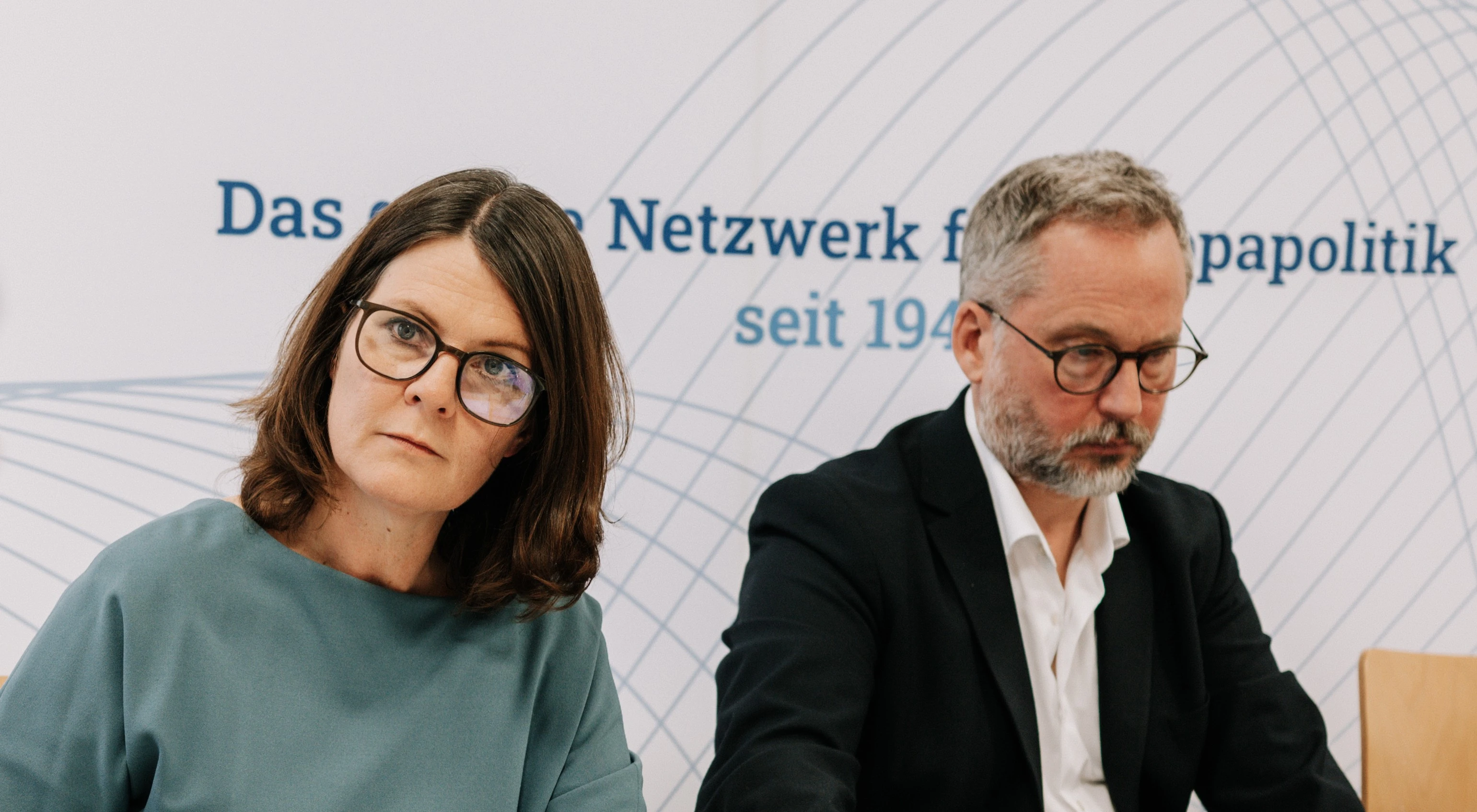
The EBD Executive Board met in Berlin on December 5 to discuss key European policy issues for 2026. One focus was the exchange with Anja Wallau, Commissioner for Fundamental Issues of European Policy, EU Coordination, and EU External Relations at the Federal Foreign Office, , Commissioner for Fundamental Issues of European Policy, EU Coordination, and EU External Relations at the Federal Foreign Office, including the German government's positions on EU reform and enlargement. The Executive Board emphasized that the planned enlargement makes reliable institutional reforms, greater capacity to act, and clear prioritization of European interests even more necessary.
In addition to reviewing the year and presenting the annual report, strategic issues relating to membership work were on the agenda. The Executive Board also welcomed a new member organization: the Zentrum Liberale Moderne (Center for Liberal Modernity). | To the follow-up report (in German)
Member participation: EBD develops its position on the MFF
Based on the key steps highlighted in our Grafik des Monats on the MFF 2028–34, EBD is currently developing its policy priorities for the coming budget period. We are actively involving our network in this process: our member organizations have been invited to contribute their priorities and assessments for the next long-term EU budget.
The evaluation is currently underway. Based on this, the EBD will develop a position that brings together the most important expectations and strengthens our lobbying efforts for a Europe capable of action. We will report on the results in the coming days.
Spotlight on social challenges
From Lisbon to Helsinki, EU citizens are concerned about affordable housing, and businesses are concerned about their competitiveness. Florian Schierle, European Affairs Officer at the Federal Ministry of Labor and Social Affairs (BMAS), informed our network at the EBD debriefing about the key outcomes of the EPSCO Council meeting in December and put them into context.
The Council meetings focused on the European Globalization Adjustment Fund as a means of providing assistance during structural changes, stricter cancer guidelines for PFAS, e-declaration for reducing bureaucracy, and the Fair Labor Mobility Package. The topic of housing was discussed in the European Semester with an increasing focus on workers' rights. | Learn more (in German)
Strong together, safe together

A defensible Europe is inconceivable without the soldiers of the German Armed Forces. This was emphasized by EBD Secretary General Bernd Hüttemann in his welcoming address at the general meeting of the German Armed Forces Association. At the same time, he made it clear that the German Armed Forces also need a strong and capable Europe.
Hüttemann emphasized that security policy challenges can only be overcome through European solutions. For example, through clear common goals, coordinated capabilities, and more efficient European procurement. He recalled that since its foundation, the EBD has been working to strengthen social resilience and a sustainable European consensus on security and defense. | Read more (in German)
EMI General Assembly in Copenhagen
The political and social development of Europe was the topic of discussion at the General Assembly of the European Movement International (EMI) in Copenhagen. The EBD was represented, among others, by Tobias Köck (EMI Vice President) and Clara Föller (EBD Board Member).
In the “Nordic Lights” panel, they discussed the role of European cooperation in security and social resilience—issues that are traditionally particularly relevant in the Nordic countries. The exchange with our sister organizations took place against the backdrop of common priorities for 2026, including the Copenhagen Declaration and the EMI's new work program.
The EBD emphasized how important internal democracy, a strong European consensus, and the commitment of pro-European member organizations remain for the work of the European Movement. | Learn more (in German)
Seizing the opportunity presented by the new EU budget
Negotiations on the next EU budget are underway, and Europe faces some key decisions. In the latest issue of EUROPA kommunal published by the RGRE, EBD President Dr. Anna-Maija Mertens emphasizes the importance of smart and democratically legitimate investments in Europe's future.
The Multiannual Financial Framework 2028–2034 could be used to advance key European priorities: social, ecological, and digital transformation, greater transparency, and a strong and competitive social market economy. Dr. Mertens also advocates creating fair EU own resources to replace national rebates without creating additional tax burdens. | Read the article (in German)
The Würth Foundation promotes European learning experiences
For three years now, the Würth Foundation has been inviting winners of the European Competition to the European Academy Berlin. The joint trip gives young people experiences that they would otherwise often be denied: hands-on political education, encounters with peers from all over Europe, and new spaces where they feel accepted and taken seriously.
This creates a European learning environment that offers equal access to young people from different backgrounds. With this commitment, the Würth Foundation is sending a strong signal for a Europe that enables all young people to participate. | To the article (in German)
Nominations for the Women of Europe Award 2026
The EBD is still looking for candidates for the Women of Europe Award 2026. We are looking for women who have made an outstanding contribution to Europe through voluntary work. Nominations can be submitted until January 10, 2026. If you or your organization are interested in honoring a committed woman, we look forward to hearing from you at pfe@netzwerk-ebd.de. | More about the nomination
College of Europe: Application period for 2026 now open
The application deadline for the 2026/27 academic year at the College of Europe is January 14, 2026. Interested parties can still apply for a place and a scholarship at the Bruges, Natolin, and Tirana campuses via the EBD. The master's program lasts ten months and offers specializations in politics, law, economics, international relations, and interdisciplinary studies.
The EBD is responsible for the German selection process and is available to answer questions about the application process and study conditions at coe@netzwerk-ebd.de. | Information about the application process (in German)
Upcoming events
December 22, 2025 | EBD De-Briefing European Council | At the end of the year, Ole Funke (Federal Chancellery) will present the results of the European Council meeting on December 18 and 19. The agenda includes the war of aggression against Ukraine, the situation in the Middle East, the next Multiannual Financial Framework, EU enlargement, migration, and Europe's competitiveness. The De-Briefing begins at 8:30 a.m. at the BDA in the House of German Business. | Further information (in German)
January 14, 2026 | EBD Briefing on the Cypriot EU Presidency | At the EBD Briefing, H.E. Maria Papakyriakou (Ambassador of Cyprus), Christoph Wolfrum (Federal Foreign Office), Susanne Szech-Koundouros (BMWE), Barbara Gessler (European Commission), and Dr. Anna-Maija Mertens (EBD President) will discuss the priorities of the Cypriot Presidency and Europe's expectations for it. The Briefing will take place at 2:00 p.m. at the European House. | More information (in German)
Check out former editions of our newsletter here.
Please sign up here if you would like to receive the newsletter (in German).
Zur deutschen Version dieses Newsletters.