EBD-Newsletter January 2026 | Why 2026 calls for bold reforms and clear European leadership
Dear readers,
The attacks on Europe's freedom and democracy have not disappeared – on the contrary, they have intensified over the turn of the year. This is evident not only in Russia's ongoing aggression against Ukraine, but also increasingly in Washington's open power politics. Europe is not a problem to be managed, but a political space that can and must assert itself. I therefore hope all the more that you were able to use the holidays to recharge your batteries. Because 2026 will require determination. Despite all the current irritations in transatlantic relations, we must not forget who is suffering most in Europe: the Ukrainian people.
A glance to the north shows just how tense the international environment is at present: new initiatives by the US, security policy responses from European partners, and contradictory trade policy signals make it clear how volatile international politics has become. This makes it all the more important for Europe to act in unison and represent its own interests with confidence. In the coming days, the EU institutions – the European Council (on Thursday), the Commission and the Parliament (plenary session this week) – will finally decide whether to take a coherent and clear stance.
Precisely because of the geopolitical situation, it is also worth looking at the island south of Turkey and off the coast of the Middle East. With the EU Council Presidency, Cyprus is moving into the center of European attention – in an orderly manner and with a clear agenda. The country is seeking to assert its place in a difficult geopolitical situation, with Europe's help. Cyprus is full of surprises: even the Turkish-speaking indigenous population in the north of the island, which remains divided to this day, are citizens of the European Union. The Cyprus question therefore remains not only a regional conflict, but also a European responsibility.
In keeping with this, our first EBD briefing of the year on January 14 focused on the Cypriot Presidency. The interview with the Cypriot ambassador clearly shows a positive realpolitik agenda that combines European autonomy with openness, multilateralism, and international cooperation. The focus is on security and defense readiness, competitiveness and the internal market, a credible enlargement policy – especially for the Western Balkans, Ukraine, and Moldova – as well as negotiations on a future-proof EU budget. The goal of the Presidency is to strengthen Europe's resilience, capacity to act, and global role in a sustainable manner, without losing sight of social cohesion and European values.
From the EBD's perspective, one thing is clear: strengthening the European single market and securing and expanding a free and democratic Europe requires bold reforms – above all by the nation states (our #EBDGrafik has everything in view). We must see the current attacks on international law, free world trade, and the free democratic basic order – whether military, economic, or rhetorical –as a wake-up call: Europe can become stronger if it stands together now.
Key decisions lie ahead. Bulgaria's accession to the euro at the beginning of the Cypriot Presidency shows that integration works when reforms, rules, and political will come together. The EU-MERCOSUR agreement has been initialled, although not yet ratified. Against the backdrop of new protectionist threats, a rules-based trade policy is becoming increasingly important. The Leaders Retreat in February on the competitiveness of the internal market (see EBD debriefing with the Chancellery at the DIHK) and the negotiations on the Multiannual Financial Framework 2028–2034 will determine whether Europe can strengthen its capacity to act in the long term – with an EU budget that continues to cost every German less than a cup of cappuccino a day.
The European Movement Germany will continue to accompany these processes in 2026 with analysis, dialogue, and networking – in critical exchange with democratic forces as well as with the Commission, Parliament, and Federal Government. Europe's strength lies in its diversity – if we finally understand it as a shared responsibility.
Bernd Hüttemann
Secretary General of the European Movement Germany e. V.
#EBDGrafik of the month

The "EBD Grafik des Monats" on Cyprus' EU Council Presidency in 2026 shows at a glance which political priorities will shape the coming months. The focus is on strategic autonomy, security, enlargement, and democratic resilience.
Cyprus' Mediterranean focus, which combines issues ranging from maritime security to migration, is particularly prominent. At the same time, the graphic clearly shows how closely competitiveness, social cohesion, and the rule of law are linked. Overall, it reveals how broad and ambitious the agenda is and how strongly it targets the European Union's long-term capacity to act. | To the "EBD Grafik des Monats"
EM Germany News
Autonomous and cosmopolitan: Cyprus' priorities for the EU
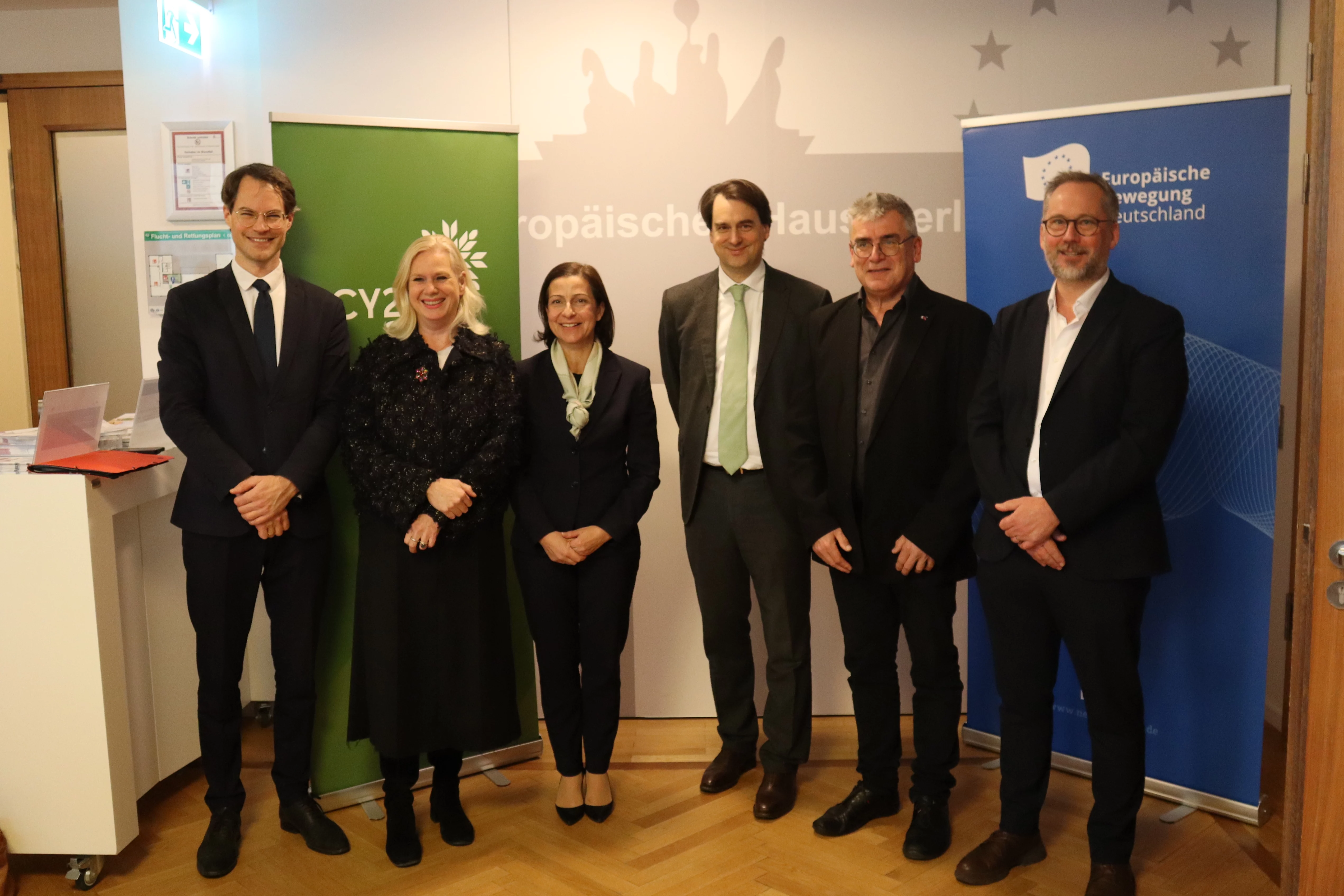
Geopolitical pressure, security policy upheavals, and economic uncertainties are forcing the European Union to make fundamental political decisions. The responses that the Cypriot EU Presidency intends to give to these challenges were the focus of the EBD-Briefing on January 14, 2026, at the European House.
The priorities were presented by H.E. Ms. Maria Papakyriakou, Ambassador of the Republic of Cyprus to Germany. In the ensuing discussion, Christoph Wolfrum (Federal Foreign Office), Dr. Rüdiger Scholz (Federal Ministry for Economic Affairs and Energy), Barbara Gessler (Representation of the European Commission), and Christian Petry, Vice President of the EM Germany, assessed the agenda from different European policy perspectives.
The guiding principle of the Presidency is a strategically autonomous and at the same time cosmopolitan EU. Cyprus has structured its agenda around five pillars: security and defense, competitiveness, openness and enlargement, an autonomous union of values, and budget and financing. | Read the follow-up report (in German)
Keeping an eye on Europe – also in 2026
The new EBD European Calendar 2026 has been published and is now available in digital form. It provides a compact overview of key European dates and events in the first half of the year, in German and English. Among other things, the calendar lists meetings of the European Council and the European Parliament, important dates for the Council of Europe, and upcoming EM Germany events. It thus provides guidance on European politics and supports planning for the coming six months.
The EBD European Calendar is a practical information aid for anyone who wants to follow, understand, or actively participate in European decision-making processes. If you would like to receive a printed copy, please contact the EM Germany; copies will be sent out while stocks last. | Download
European movements in dialogue: EBD at the General Assembly in France
How European movements can strengthen Europe's capacity to act was the topic of the General Assembly of the European Movement France. Dr. Anna-Maija Mertens, President of the European Movement Germany, participated in the discussions on behalf of the EBD.
In discussions with Hervé Moritz, President of the European Movement France, and representatives of the European Movement Italy, she discussed the current challenges facing the European Union. Dr. Anna-Maija Mertens made it clear that 2026 will be a key year for Europe: in view of geopolitical upheavals, continued Russian aggression, and growing uncertainties, there is a need for an EU that acts more strategically, decisively, and confidently.
At the same time, she emphasized the special role of the European Movement: European strength can only be achieved if political decisions are supported by broad social alliances. Close cooperation between national movements is therefore not a formality, but a strategic prerequisite for a democratic European future. | Read more
Focus on European policy at the end of the year

At the EBD De-Briefing on the European Council on December 22, 2025, the EM Germany looked back on the European Council meeting of December 18 and 19. The focus was on support for Ukraine, the EU's trade agreement with Mercosur, and the reorganisation of the Multiannual Financial Framework 2028–2034. The debriefing thus provided an overview of European decision-making in a phase of high political intensity at the end of the year.
Arne Franke (BDA) welcomed the participants as host. Ole Funke (Federal Chancellery) assessed the results from the perspective of the German government. In their initial comments, Gosia Binczyk (European Commission) and Prof. Dr. Funda Tekin (EM Germany Executive Board) evaluated the decisions before the subsequent discussion was moderated by Bernd Hüttemann. | To the follow-up report (in German)
How Europe is planning its environmental future
Where is Europe's environmental policy headed? At the EBD De-Briefing Environment, Dr. Wolfgang Seidel (Federal Ministry for the Environment, Climate Protection, Nature Conservation, and Nuclear Safety) summarized the key decisions and discussions of the Environment Council meeting on December 16.
Topics discussed included the guidelines for “Europe's Environment 2030,” the further development of the EU Bioeconomy Strategy, the European Commission's Environmental Omnibus, and the environmental policy priorities of the upcoming Cypriot Council Presidency. | To the follow-up report (in German)
Council of Europe: Change in EM Germany Democracy Ambassadors
The EM Germany welcomes Melanie Thut as the new EM Germany Democracy Ambassador. As Federal Chair of the Young European Federalists and member of the board of Europa-Union Germany, she has been committed to the democratic future of Europe for many years. In 2025, she was named one of the 100 most influential personalities in the German-speaking EU scene by Table.Briefings.
Melanie Thut succeeds Clara Föller, whom the EM Germany warmly thanks for her great commitment as Democracy Ambassador. From January 2026, Clara Föller will contribute her European policy perspective in her new role on the Advisory Council on Youth of the Council of Europe. She will remain closely associated with the EM Germany as a member of the board. More about our Council of Europe project and the Democracy Ambassadors (in German).
Interview with...

Botschafterin der Republik Zypern Maria Papakyriakou
The “Interview with…” format regularly features European voices in the form of short interviews. On the occasion of Cyprus' EU Council Presidency since January 1, 2026, we spoke with H.E. Ms. Maria Papakyriakou, the Cypriot Ambassador in Berlin, about the priorities of the Cypriot program. In the interview, she presents the key priorities of the Presidency – from strategic autonomy and competitiveness to EU enlargement and reforms to the negotiations on the Multiannual Financial Framework – and places them in the context of current geopolitical challenges.
Madam Ambassador, on 1 January 2026, the Republic of Cyprus will take over the EU Council Presidency from Denmark for a six-month term. What are the key priorities of the Cypriot programme?
H.E. Ms. Maria Papakyriakou: On 1 January 2026, the Republic of Cyprus has assumed the EU Council Presidency for the second time since joining the EU, with a programme guided by the overarching vision of European autonomy. Our core objective is to strengthen the European Union’s capacity to act independently where necessary, while remaining firmly committed to openness, multilateralism and international cooperation.
The Cypriot programme is structured around five interconnected priorities.
First, the Cyprus Presidency will work towards a more autonomous and secure Europe. This includes strengthening the Union’s defence readiness and strategic autonomy, reducing critical dependencies, addressing hybrid, cyber and maritime threats, and supporting the swift implementation of key defence initiatives, including the White Paper on the Future of European Defence and the Readiness Roadmap 2030. Continued, unwavering support for Ukraine in the face of Russia’s war of aggression is a central element, alongside effective migration management, enhanced preparedness and resilience, and the protection of democracy and the rule of law.
Second, our programme places strong emphasis on competitiveness as the foundation of European autonomy. The Presidency will prioritise regulatory simplification, completion of the Single Market, strengthening industrial competitiveness, advancing the green and digital transitions, deepening capital markets, enhancing energy security and affordability, and reinforcing digital sovereignty in key technologies such as artificial intelligence, cloud infrastructure and cybersecurity.
Third, Cyprus will promote an autonomous Union, open to the world. Cyprus considers enlargement to be a strategic investment in Europe’s future, and is firmly committed to advancing the process in a credible, merit-based approach, including for the Western Balkans, Ukraine and Moldova. The Presidency will also work to revitalise partnerships with the Southern Neighbourhood and the Gulf, strengthen transatlantic relations, diversify trade partnerships, uphold the rules-based multilateral system, and reinforce the EU’s role as a global provider of development and humanitarian assistance.
Fourth, our program underlines that European autonomy is rooted in its people and values. Our Presidency will focus on strengthening the rule of law, social cohesion and inclusion, tackling poverty, promoting affordable housing and energy, protecting children, advancing gender equality and disability rights, supporting youth participation, investing in skills, education and lifelong learning, and strengthening the European Health Union, with particular attention to mental health.
Finally, our program highlights that strategic autonomy requires a sufficient and well-targeted budget. Advancing negotiations on the Multiannual Financial Framework 2028–2034 is therefore a key priority, with the aim of shaping a balanced and mature framework that enables the Union to meet its long-term objectives, respond to crises, enhance competitiveness and security, and accommodate future enlargements.
Together, these priorities reflect an ambitious, results-oriented agenda aimed at reinforcing the EU’s autonomy, resilience and global role, while ensuring that no citizen or region is left behind.
Upcoming events
January 27, 2026 | EBD De-Briefing AGRIFISH | At the EBD De-Briefing, Dr. Andreas Flach (Federal Ministry of Agriculture, Food, and Rural Affairs) will present the German government's assessment of the meeting of the Agriculture and Fisheries Council. The focus will be on the planned amendments to the EU Organic Regulation, the EU Bioeconomy Strategy with regard to agriculture, forestry, and fisheries, and the evaluation of the Unfair Commercial Practices Directive. The debriefing will begin at 1:30 p.m. | Further information (in German)
February 6, 2026 | EBD De-Briefing ECB Governing Council | On the occasion of the meeting of the Governing Council of the European Central Bank on February 4 and 5, the EBD De-Briefing will focus on the monetary policy situation in the euro area. The event will take place at the Sparkassenhaus in cooperation with the German Savings Banks Association (DSGV) and the European Central Bank (ECB). Guests include Gabriel Glöckler, Principal Adviser in the Directorate General Communications, and Bettina Landau, Senior Adviser (both ECB). They will explain the monetary policy decisions of the Governing Council and will be available for questions afterwards. | Further information to follow (in German)
February 13, 2026 | EBD De-Briefing Informal European Council on Competitiveness | The EBD De-Briefing will provide information on the results of the informal European Council (Leaders' Retreat) on February 12, 2026, which will focus on issues of European competitiveness. The event will take place in cooperation with the German Chamber of Industry and Commerce (DIHK) at the Haus der Deutschen Wirtschaft. Ole Funke (Federal Chancellery) will summarize the results. Initial comments will be provided by Barbara Gessler (representing the European Commission) and Dr. Anna-Maija Mertens, President of the EM Germany. | Further information to follow (in German)
Check out former editions of our newsletter here.
Please sign up here if you would like to receive the newsletter (in German).
Zur deutschen Version dieses Newsletters.