EBD Newsletter July 2026 | Europe’s Strength Depends on Unity
Dear readers,
“Ní neart go cur le chéile” – strength comes through unity. Under this motto, Ireland took over the Presidency of the Council of the European Union on 1 July for the eighth time. Its programme focuses on competitiveness, values and security – three priorities that are closely aligned with the EU’s Strategic Agenda 2024–2029 and, from the perspective of EBD policy, point in the right direction. Europe’s capacity to act is not determined by economic strength alone, but by whether democracy, the rule of law, social cohesion and a sustainable social market economy are considered together.
In many respects, the Irish programme is compatible with EBD’s priorities: clear support for Ukraine, a strong focus on democracy and the rule of law, an ambitious enlargement agenda, the strengthening of European defence capabilities, social inclusion, as well as the further development of the Single Market, the Savings and Investments Union, digital infrastructure and strategic resilience. It is particularly positive that competitiveness is not reduced to questions of costs, but is linked to security, investment, innovation, energy supply, digitalisation and social cohesion. This is precisely what our EBD focus topics are about.
The political challenges in the second half of the year are immense. The Multiannual Financial Framework 2028–2034 must underpin the EU’s political commitments: support for Ukraine, enlargement, cohesion, research, security, climate action and social stability all require a solid financial basis. It is therefore right that the Irish Presidency makes a timely agreement on the next EU budget an overarching priority. Germany must now engage constructively in this process and avoid reducing the debate to net contributor arguments.
Enlargement remains equally decisive. When Dublin sets out the objective of preparing the ground for the first accession of new Member States since 2013, this sends an important signal to Ukraine, Moldova, Southeast Europe and all democrats across Europe. Yet a larger Union also needs to be a more reform-capable Union. Here, the programme remains too cautious. More qualified majority voting in the Council, a stronger European Parliament, the use of passerelle clauses and a serious debate on a European Convention must be placed on the agenda. Europe’s capacity to act must not fail because of unanimity.
Implementation will also be decisive when it comes to Better Regulation. Simplification can strengthen Europe if procedures become more comprehensible, participation takes place earlier and rules become more effective. But it must not lead to a lowering of standards. The Omnibus packages must be assessed according to whether social, health and environmental protection standards are genuinely safeguarded and whether civil society actors, social partners and economic actors are involved at an early stage. The same applies to Schengen: security, migration and open internal borders must not be played off against one another. Permanent internal border controls damage trust, regions, businesses and the lived reality of the Single Market.
With our EBD Briefing on the Irish Presidency of the Council of the EU, we accompanied this opening phase in exchange with the Irish Embassy, the Federal Government, the European Commission and our network. The new EBD European Policy Calendar 2026/2 provides orientation for a politically dense second half of the year. And our recent EBD survey on the role of companies in democratic resilience shows that democracy has long since become a factor in business location and competitiveness. Eighty percent of the executives surveyed believe that companies have a responsibility to strengthen democracy; 78 percent see a link between democratic stability and economic success.
With its programme, Ireland provides a solid pro-European foundation. What matters now is to embed it more strongly in democratic, social and institutional terms – and for Berlin to engage proactively. EBD will accompany this process in a critical and constructive spirit: as a network, a platform for dialogue and a voice for a German European policy that strengthens Europe’s capacity to act without weakening its democratic foundations.
Best regards,
Bernd Hüttemann • Secretary General of European Movement Germany e.V.
#EBDGrafik of the month
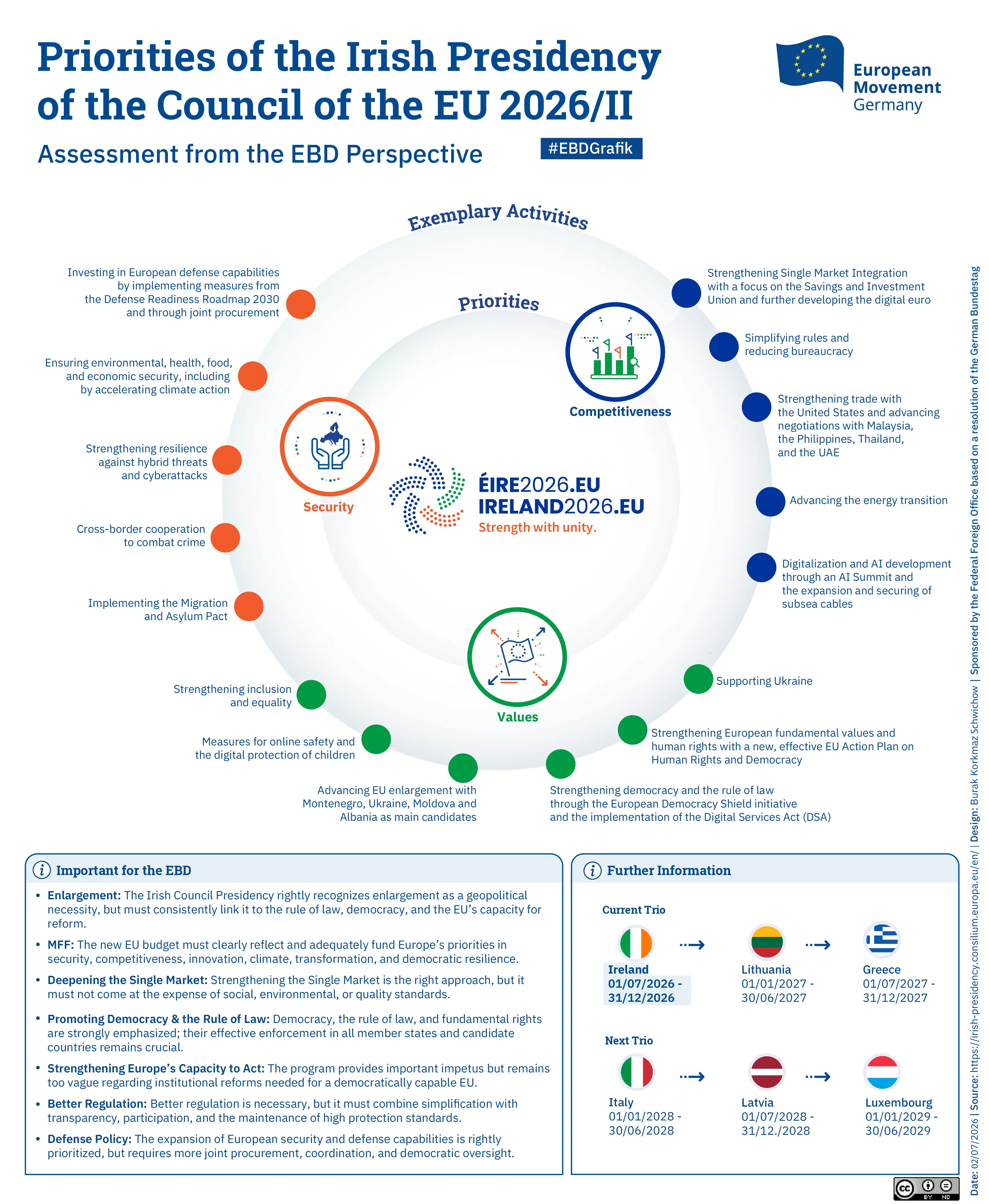
On July 1, 2026, Ireland assumed the presidency of the Council of the European Union, marking the start of the trio presidency comprising Ireland, Lithuania, and Greece. Competitiveness, values, and security define the priorities of the Irish presidency.
Our Graphic of the Month provides an overview of the priorities of the Irish Presidency and compares them with the EM Germany’s positions on European policy. It demonstrates where the EBD supports the agenda, where further action is needed, and what its expectations are for the coming six months. | View the Graphic of the Month
EM Germany News
EBD Briefing on the Irish Presidency of the Council of the European Union
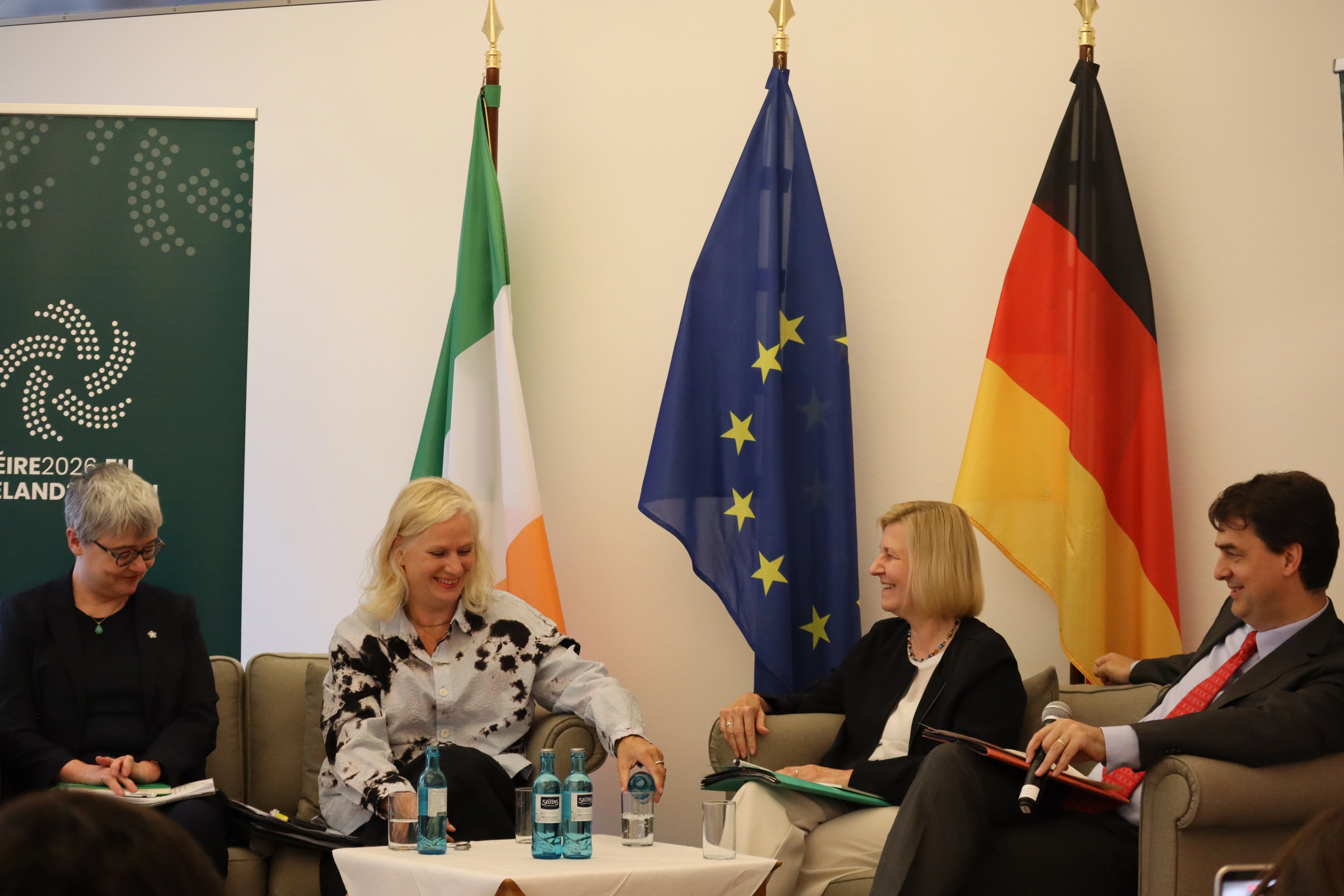
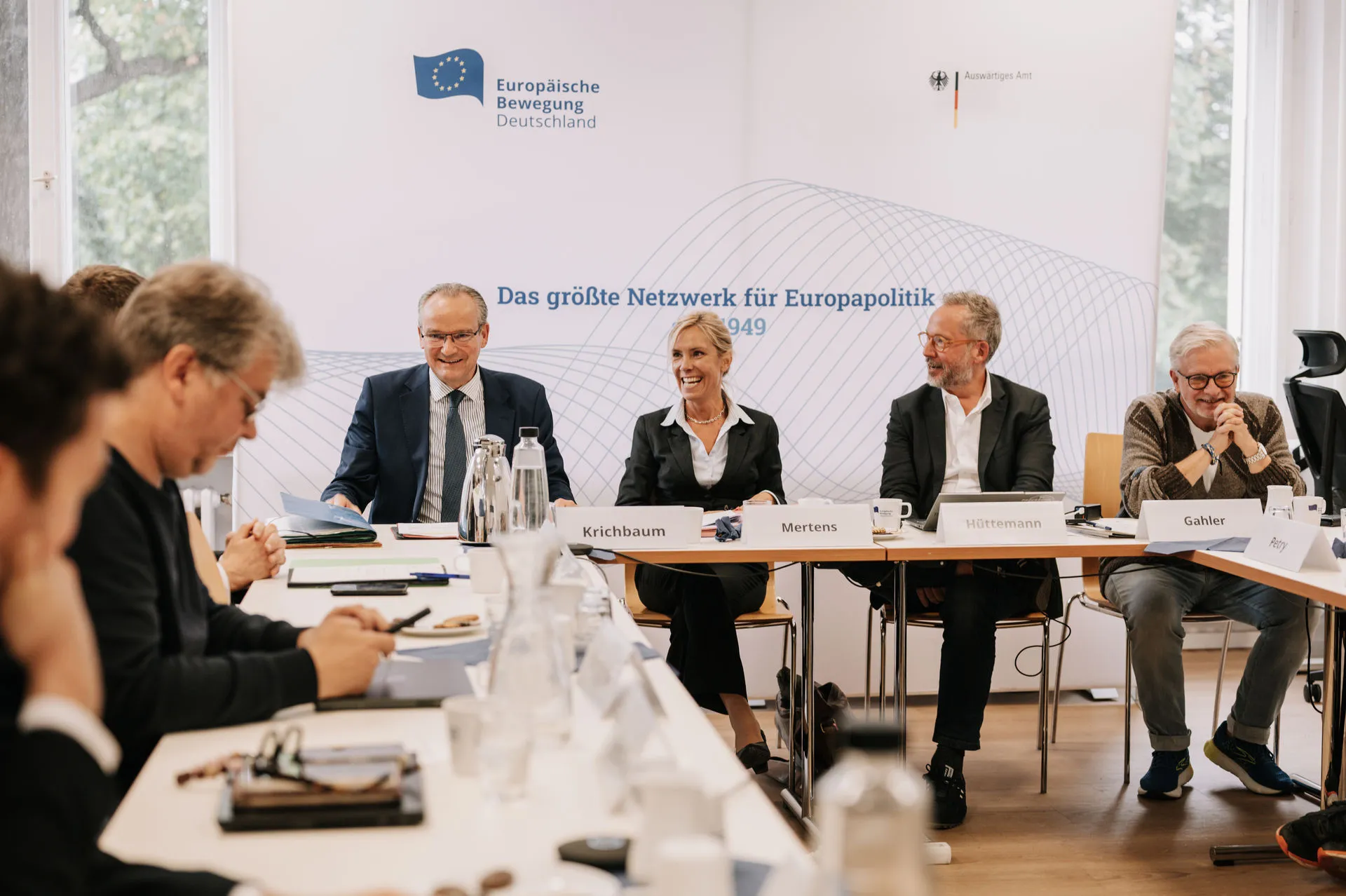
To mark the start of Ireland’s EU Council Presidency, the EM Germany, together with the Embassy of Ireland in Berlin, hosted an EBD Briefing on July 6, 2026. Ambassador H.E. Maeve Collins provided an overview of the Council Presidency’s priorities and objectives. Under the motto “Ní neart go cur le chéile – Strength with unity,” Ireland aims to strengthen European competitiveness, defend shared values, and advance European security in the coming months. At the same time, negotiations on the Multiannual Financial Framework for 2028–2034 are of particular importance.
This presentation of priorities was followed by an assessment of the German government’s position by Christoph Wolfrum (Federal Foreign Office) and Gisela Hohensee (Federal Ministry for Economic Affairs and Energy). Barbara Gessler, the European Commission’s representative in Germany, and EM Germany Vice President Julian Joswig, Member of the Bundestag, provided additional European and parliamentary perspectives. Topics discussed included, among others, the deepening of the single market, Europe’s technological sovereignty, support for Ukraine, European security and defence policy, and EU enlargement. The subsequent Q&A session, moderated by EM Germany Secretary General Bernd Hüttemann, also addressed the European Union’s capacity for reform, European linguistic diversity, the digital euro, and the future of the Schengen Area. | Read more here (in German)
New 2026 European Calendar Published
What events of the Council of Europe are coming up in the next six months? When will the various EU institutions meet? And which EM Germany events can you look forward to? The new EBD European Calendar 2026/2 provides a concise overview of these and many other dates and events of European politics. It serves as a reliable guide for anyone who wants to closely follow European politics and decision-making processes. We’ll be happy to send you printed copies upon request. | Click here to download
Strengthening Europe’s Capacity to Act: EM Germany General Assembly 2026 Sets Political Priorities
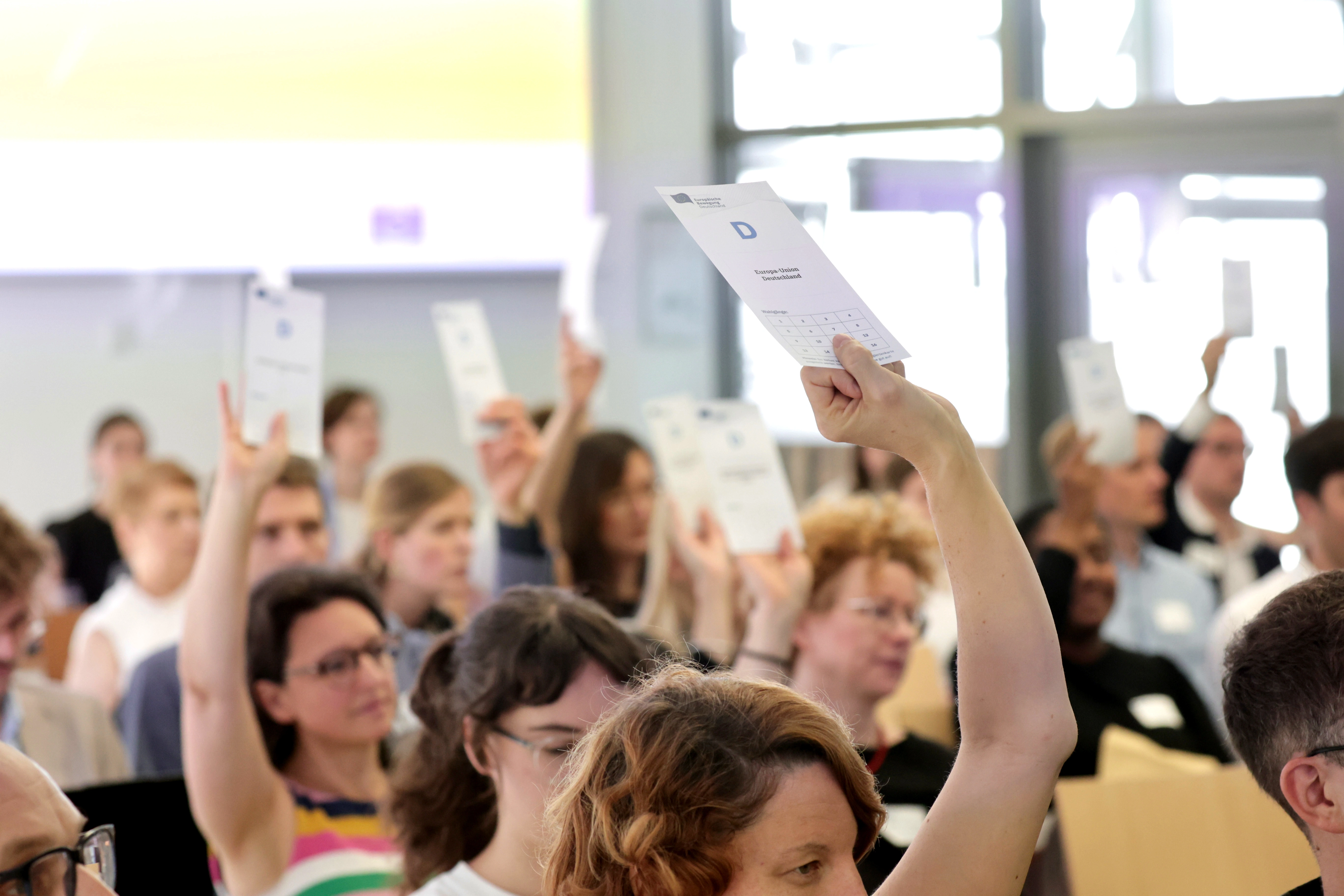
With the adoption of the EBD Policy 2026/27, the EM Germany General Assembly, held on June 22, 2026, at the German Farmers’ Association in Berlin, established the political and strategic priorities for the coming year. The member organisations agreed on four key focus areas: Europe’s capacity for democratic action, Europe’s foreign policy responsibilities, European education and social participation, as well as the further development of the single market.
For EM Germany President Dr. Anna-Maija Mertens, Europe’s capacity for action is the decisive test for security, prosperity, and democracy. The EM Germany sees its mission in translating social diversity into collective European action. Sebastian Fischer (Federal Foreign Office) and Tobias Flessenkemper (Council of Europe) also provided input for the debate on European policy. They addressed current developments at the EU and Council of Europe levels, thereby building on the discussions about democracy, human rights, and the rule of law. | Read more here (in German)
New EM Germany Executive Board Elected

On June 22 2026, the EM Germany General Assembly elected the Executive Board for the upcoming term. The EM Germany extends its warmest congratulations to all newly elected and re-elected members of the Executive Board. Special congratulations go to Dr. Anna-Maija Mertens on her reelection as President, as well as to Julian Joswig, Member of the German Bundestag (MdB), who will join EM Germany Vice Presidents Michael Gahler, Member of the European Parliament (MEP), and Christian Petry.
Also new to the Executive Board are Roland Theis, Member of the German Bundestag (CDU); Luca Loreen Kraft (Volt Deutschland); Nicolas Engelbarts (dbb beamtenbund und tarifunion); Livia Hentschel-Wark (DGB); Marie von Manteuffel (Caritas Foundation Germany); Carolin Robert (JEF Germany); and Irene Hahn-Fuhr (Center for Liberal Modernity).
The EM Germany would also like to extend its sincere thanks to the outgoing Executive Board members for their many years of dedication and commitment to the network. We look forward to working together on European politics. | Read more here (in German)
EU Enlargement, Competitiveness, and Security | EBD Debriefing on the European Council
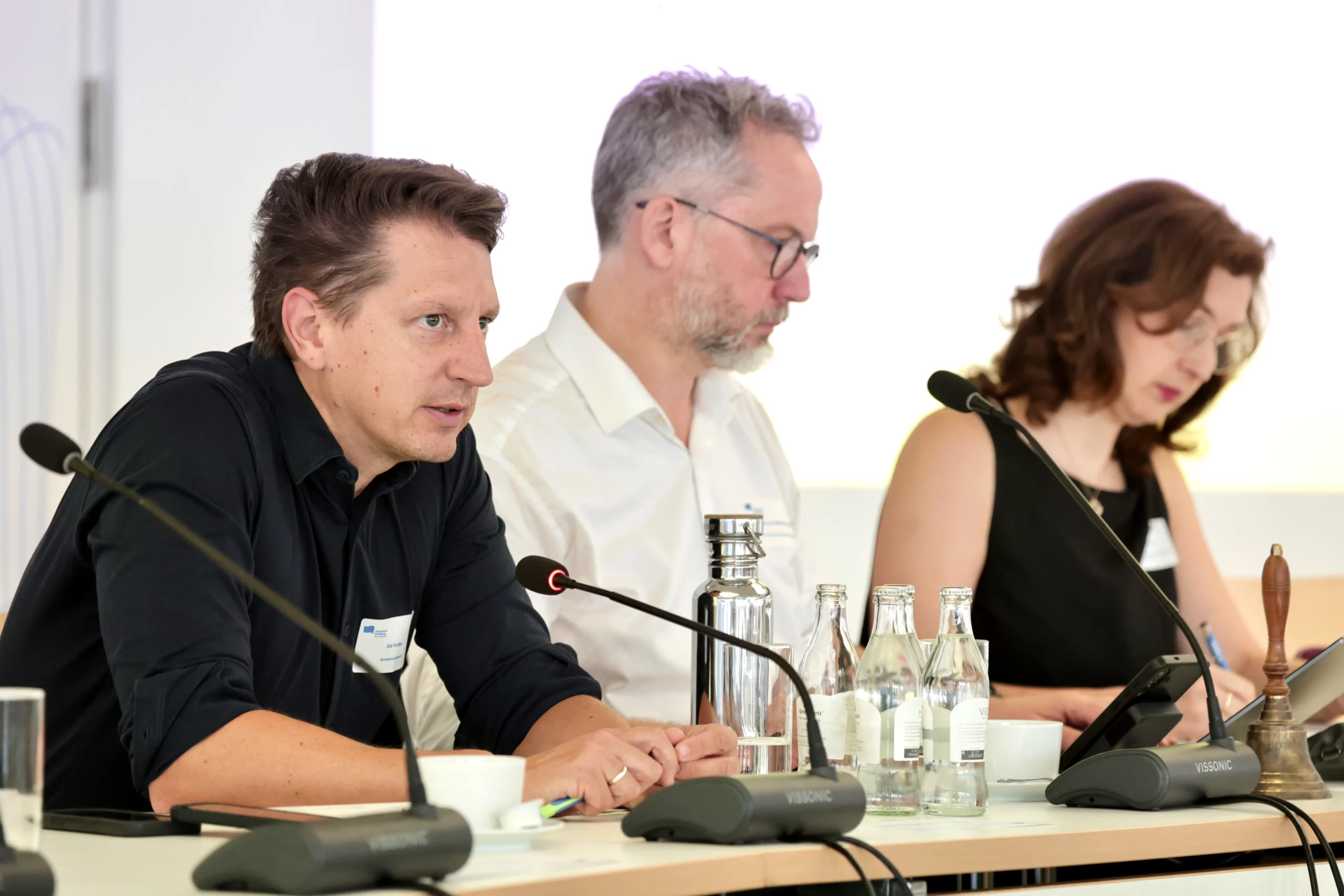
Competitiveness, defence, and EU enlargement must be considered strategically and viewed in relation to one another. This insight also shaped the EBD De-Briefing on the European Council meeting of June 22, 2026. Ole Funke (Federal Chancellery) analysed the outcomes of the June European Council meeting from the perspective of the German federal government. Initial comments were provided by Gosia Binczyk (Representation of the European Commission in Germany) and EM Germany President Dr. Anna-Maija Mertens.
Topics discussed included support for Ukraine, European competitiveness, the Multiannual Financial Framework, EU enlargement, and the European Union’s defence capabilities. During the subsequent Q&A session, the focus was on, among other things, trade policy instruments, safeguard measures, and the ongoing negotiations on the Multiannual Financial Framework. | Read more here (in German)
EM Germany Participates in the Council of Europe’s Youth Consultation on the New Democratic Pact
What are 120 young people from all over Europe doing in Strasbourg for three days? They are working together to develop recommendations for the future of democracy in Europe. That was precisely the focus of the Council of Europe’s “Youth Innovating Democracy” conference, held June 24–26 at the European Youth Center. The EM Germany was represented at the event by its advisor on European political education, Enno Coordes.
The participants drafted a consultation contribution from a youth perspective for the New Democratic Pact for Europe. Council of Europe Secretary General Alain Berset emphasised that this initiative, as an ongoing process, thrives on dialogue and the inclusion of diverse perspectives. The EM Germany is also contributing to the consultation process with its representative corporate survey on the role of business in democracy, as well as the planned Berlin Democracy Declaration 2026. The joint youth contribution is scheduled to be published at a later date. The EM Germany will subsequently report on the results.
EBD Survey: The Role of Businesses in Democratic Resilience in Germany - Challenges, Responsibilities, and Benefits
For many businesses, democratic stability, the rule of law, and trust in institutions are key prerequisites for economic success. This is the conclusion reached by the aforementioned EBD survey on the role of businesses in democratic resilience in Germany.
At the same time, the survey shows that public statements on fundamental democratic issues meet with high levels of approval and are perceived as an important form of nonpartisan engagement. However, there is a significant gap between this attitude and actual implementation. While many respondents would like to see greater engagement from businesses, only a few have implemented corresponding measures so far. | Read more here (in German)
National Prize Winners Visit the Federal Chancellery
Thirty national prize winners of the 73rd European Competition were rewarded with a special trip to Berlin. At the Federal Chancellery, Chancellor Friedrich Merz personally welcomed the young people and discussed their perspectives on Europe with them. The trip to Berlin also offered participants insights into the work of German and European institutions. The event concluded with a week-long public exhibition of the award-winning competition entries at the visitor center of the Federal Government Press and Information Office. | Read more here (in German)
In Memory of Ursula Schleicher
It is with great sadness that the European Movement Germany e.V. bids farewell to Ursula Schleicher, who passed away on June 18, 2026, at the age of 93.
Ursula Schleicher was closely associated with the European Movement Germany for decades. She served on the Executive Committee beginning in 1974, and from 1980 to 2007, as Vice President, she played a decisive role in shaping the work of the EM Germany, contributing in particular to the realignment and stabilisation of the organisation in the early 2000s. She left a lasting legacy with the establishment of the Women of Europe Award in 1991. Through this award, which continues to this day, she raised the visibility of women in European engagement and honored their commitment to Europe and its values.
As a longtime Member of the European Parliament and Vice President of the European Parliament, Ursula Schleicher championed European unity with great conviction. The European Movement Germany will remember her with gratitude as a dedicated companion and a staunch European. Our thoughts are with her family and all those who were close to her.
Interview with …
In our “Nachgefragt bei…” series, European voices regularly share their perspectives in short interviews.
In this issue, we speak with David Geary, CEO of the European Movement Ireland; who, in the context of Ireland’s EU Council Presidency, offers insights into the political and public discourse in Ireland and sheds light on how the EU and Ireland’s own membership are perceived

Ireland has been a member of the European Union since 1973 and has adopted the euro. How do people in Ireland currently view the European Union?
David Geary: "Irish public support for the EU remains consistently one of the highest in Europe. According to European Movement Ireland’s 2026 poll, 82% of the Irish public supports Ireland’s continued membership, which we know places Ireland well above the EU average. While this support is heartening, our annual polling also demonstrates growing public dissatisfaction with the EU’s performance. Only 45% of people in the Republic believe the EU is moving in the right direction. Among some of the key issues of concern expressed across a range of questions, are the EU’s response to migration, economic and regulatory issues, federalism and sovereignty concerns and the EU’s response to foreign policy. Our poll findings also reflect the public appetite for a more confident and independent Europe vis-à-vis our relationship with the US, which isn’t so surprising given the unpredictability in EU-US relations in areas of trade, security and digital regulation. " | Read the full interview
Check out former editions of our newsletter here.
Please sign up here if you would like to receive the newsletter (in German).
Zur deutschen Version dieses Newsletters.