EBD-Newsletter April 2026 | Democratic Renewal in Hungary – A Signal for Europe
Dear Readers,
The election result in Hungary marks a political moment whose significance extends beyond national borders and could become a broader trend. The success of the pro-European opposition reflects a development that has been repeatedly confirmed across Europe: over the long term, open societies, rule-of-law institutions, and democratic processes generate a degree of stability and innovative capacity that autocratic and kleptocratic systems cannot attain. This should give us hope with regard to the world, Europe, and our own country as well, where, for the first time, the opponents of Europe and its values are now leading in the polls.
Yet this election result is only a beginning: Hungary now faces the difficult task of restoring trust in state institutions and democracy, effectively combating corruption, safeguarding media freedom, and consistently strengthening respect for human rights. This is about nothing less than reclaiming democratic room for manoeuvre in the European context—and thus also about the European Union’s capacity to act.
This dynamic shows that the internal condition of the Member States is closely linked to Europe’s ability to act. Recent developments have demonstrated how ruthlessly individual Member States use key decisions in foreign and security policy as leverage in order to advance other interests. The debate on the principle of unanimity is therefore directly connected to European sovereignty.
Europe is facing a twofold task: it must safeguard its values internally while at the same time strengthening its capacity to act externally. Especially at a time when reform demands driven by migration policy are gaining traction, clarity is needed: the protection of fundamental and human rights is non-negotiable. How central this guiding principle remains was also clearly underscored both by our EM Germany expert discussion with Prof. Dr. Anja Seibert-Fohr, Judge at the European Court of Human Rights in Strasbourg, and by our EBD Public Diplomacy event with representatives of the pro-European Serbian opposition.
Hungary shows that defending our shared values internally and strengthening the EU’s capacity to act externally go hand in hand—and that democratic renewal is possible. What matters is that we seize this momentum and actively shape the future of Europe.
Yours sincerely,
Dr Anna-Maija Mertens
President of the European Movement Germany (Europäische Bewegung Deutschland e.V.)
EM Germany News
Strengthening the European Convention on Human Rights: the ECHR as a central pillar of the European values system

75 years after its adoption, the European Convention on Human Rights is once again at the centre of political debate. The EM Germany emphasises its importance as the foundation for the protection of fundamental rights and the rule of law in Europe. It welcomes the fact that no amendment to the Convention is currently planned within the Council of Europe, simultaneously it warns for political attempts to influence its interpretation and the case law of the European Court of Human Rights.
In light of current discussions, particularly regarding migration and security policy, the EM Germany brought together key perspectives in a background discussion. Prof. Dr Anja Seibert-Fohr, Judge at the European Court of Human Rights, and Prof. Dr Lars Castellucci, Member of the German Bundestag and Federal Government Commissioner for Human Rights Policy and Humanitarian Aid, discussed with representatives from the political sphere and the professional public how the Court’s case law is perceived in political debates and how misunderstandings can be reduced and confidence in European human rights protection strengthened. | German Press Release
EU–Turkey Relations in Focus: EBD Public Diplomacy Exclusive Turkey

Against an increasingly tense geopolitical backdrop, relations between the European Union and Turkey took centre stage at the European Policy Salon organised by the EM Germany and the EM Turkey on April 20, 2026 in Istanbul. The event brought together a deliberately small group of stakeholders from the fields of politics, diplomacy, the press and European policy-making.
Discussions centred around the future of EU–Turkey relations, Europe’s role between conflict management and cooperation, and the significance of international cultural relations. Contributions were made by Dr. Regine Grienberger, Consul General of the Federal Republic of Germany in Istanbul, and Prof. Dr Gesche Joost, President of the Goethe-Institut. The event was opened by EM Germany Secretary-General Bernd Hüttemann and Emre Gür, President of the EM Turkey. | Read more
Pressure for reform and crisis management
War, economic uncertainties and mounting pressure for reform are currently shaping the European agenda. Against this backdrop, the EM Germany De-briefing on March 23, 2026 provided an analysis of the outcomes of the European Council meeting on March 19 and 20. Ole Funke (Federal Chancellery) and Gosia Binczyk (Representation of the European Commission in Germany) provided an overview of the discussions. Konrad Klingenburg (DGB) gave the welcome address, with EM Germany Secretary-General Bernd Hüttemann acting as moderator; a political analysis was provided by EM Germany President Dr. Anna-Maija Mertens.
The discussions focused on further specifying the competitiveness agenda, progress in the single market – for instance regarding the ‘28th regime’ – as well as debates on energy prices and climate policy. The removal of bureaucratic hurdles and regulatory duplication was also highlighted as a key prerequisite for economic dynamism. It became clear that a Union capable of taking action requires not only economic and institutional reforms, but also political cohesion and reliable decision-making processes. The debriefing took place at the Hans-Böckler-Haus with the kind support of EM Germany member organisation DGB. | Read more
CO2, Climate & Diplomacy: The EU’s Environmental Agenda
The EM Germany De-briefing on March 19, 2026 focused on how European climate and environmental policy is evolving under current political and economic conditions. Together with Dr. Wolfgang Seidel (BMUKN), the discussions at the Environment Council on March 17, were analysed. Fabian Häring (EM Germany) chaired the session.
The focus was on the revision of CO2 emission standards, the shaping of climate policy beyond 2030, and the further development of the EU Emissions Trading System. The discussion also addressed the tension between climate policy objectives and industrial policy interests, particularly regarding technology-neutral approaches to emissions reduction. Another key aspect was the international climate diplomacy and the role of multilateral cooperation in a changing political environment. Evidently it was highlighted that key issues in European environmental policy remain in a dynamic and, in some cases, controversial phase of negotiation. | Read more
Strategic corruption as a challenge to European democracy
The Azerbaijan affair has shown how targeted influence-peddling can undermine democratic processes in Europe. At the EM Germany dialogue on strategic corruption, the focus was therefore on the question of how vulnerable political systems are to such forms of systematic influence-peddling and what conclusions need to be drawn from this. Together with Transparency International Germany, the EM Germany discussed structural challenges in tackling strategic corruption and its impact on European decision-making processes. Dr. Anna-Maija Mertens (EM Germany President) and Alexandra Herzog (Transparency International Germany) opened the session by emphasising the importance of consistent anti-corruption efforts for the trust and credibility of democratic institutions.
During the panel discussion, Frank Schwabe MP and Filiz Polat MP (both members of the German delegation to the Parliamentary Assembly of the Council of Europe), Public Prosecutor Radbod Rad (Düsseldorf Public Prosecutor’s Office) and Margarete Bause (board member of Transparency Germany) used specific case studies to examine mechanisms of targeted influence as well as shortcomings in investigation and sanctioning. The role of international supervisory bodies such as the Council of Europe was also discussed, as were necessary reforms – ranging from stricter transparency rules to improved international cooperation. | Read more
College of Europe Selection Committee
The decision on who will study at the College of Europe in future is also made in Berlin: from March 30 to April 1, 2026, the Selection Committee for the coming academic year met at the General Secretariat of the EM Germany. On behalf of the Federal Ministry of Research, Technology and Space, German applicants were selected through personal interviews.
The EM Germany has been organising the selection process since 1949 and supports the students throughout their journey. The members of the Selection Committee – Prof. Dr Sieglinde Gstöhl, EM Germany Board Member Dr. Thu Nguyen, Dr. Sebastian Steingass and Prof. Dr Ferdinand Fichtner, chaired by Prof. Dr. Stefan Froehlich – contributed their expertise to the selection process. The sheer number and diversity of the applications demonstrated once again that committed individuals from a wide variety of backgrounds want to play an active role in shaping Europe’s future. | Read more
Exhibition featuring works from the 73rd European Competition opens in Berlin
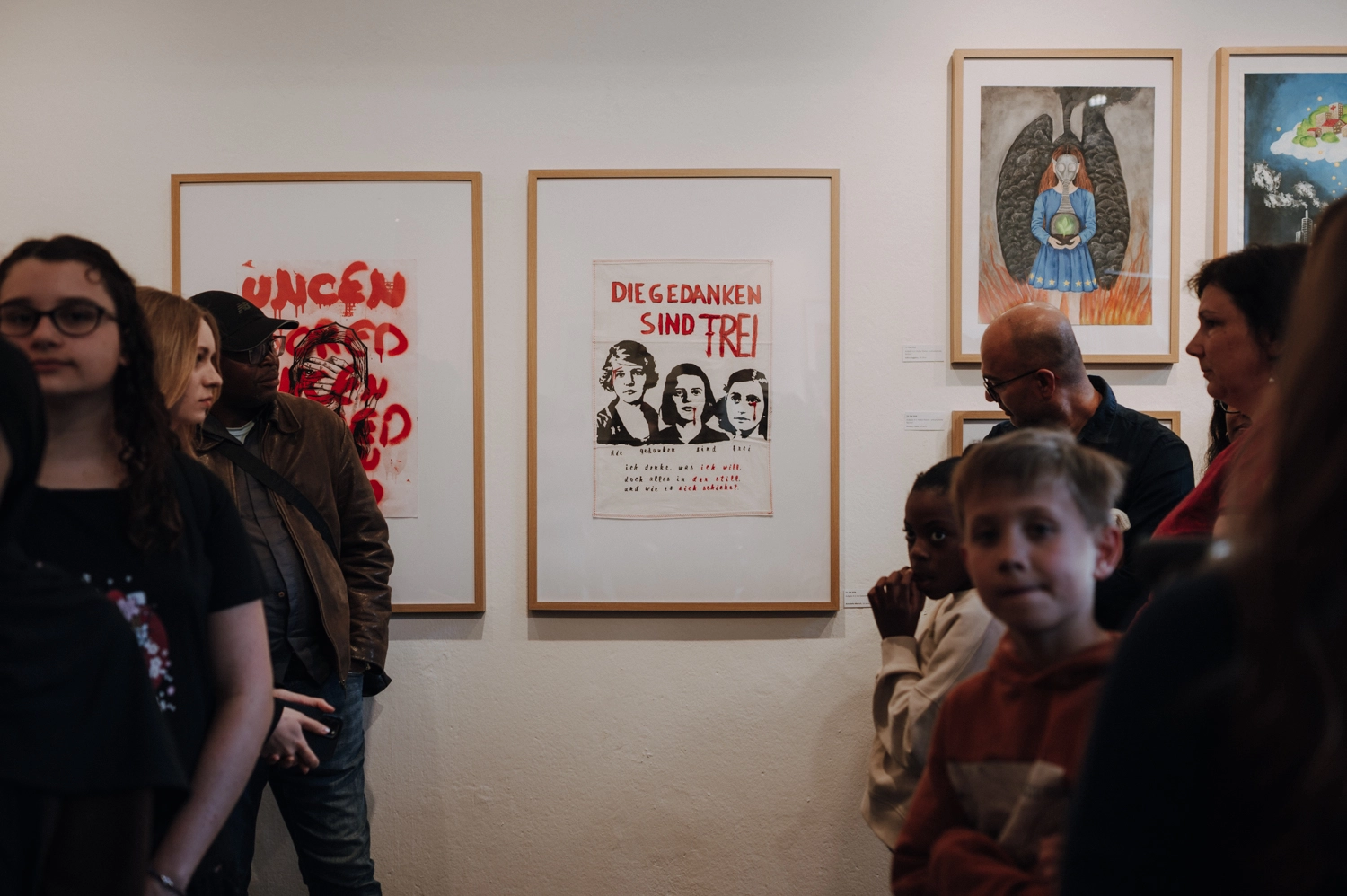
On April 17, 2026, the well-attended opening event ‘Standing Up for Human Rights’ took place at the Klax Children’s Art Gallery in Berlin. Numerous guests paid tribute to the impressive contributions by children and young people on human rights and European values. The works address current social issues and offer creative, personal and very powerful insights. The exhibition highlights how committed young people are regarding engaging with freedom, diversity and cohesion – and how strongly they stand up for human rights. It runs until the end of May and invites visitors to discuss the future of Europe. | Further information
Upcoming Events
April 28, 2026 | Film screening and panel discussion: (IN)VISIBLE LINES
The Federal Foundation for Gender Equality, in collaboration with the ‘Prize for European Women’ network and with the support of the EM Germany, invites you to a film evening followed by a panel discussion.
The documentary (IN)VISIBLE LINES follows refugee women and depicts their daily lives, caught between self-determination and structural barriers. Afterwards, the filmmakers Paula and Lena Boden, along with Marie von Manteuffel – winner of the 2025 “Women of Europe Award” – will discuss migration, participation and European responsibility. | To register
May 4, 2026 | Women of Europe Award 2026 Ceremony
As part of the Europe Weeks, the EM Germany, together with the European Commission Representation in Germany and with the support of the Council of Europe, will present the “Women of Europe 2026” award. The award goes to political scientist Prof. Dr Gabriele Abels and democracy and human rights activist Ina Rumiantseva – one of the most prominent voices of the Belarusian diaspora in Germany – for their outstanding commitment to European integration, democracy and human rights. | Event details
May 7, 2026 | EM Germany De-briefing ECOFIN
On May 7, the EM Germany is hosting a debriefing on the meeting of the Economic and Financial Affairs Council (ECOFIN) held on May 5, 2026. The focus will be on economic and fiscal policy issues within the European Union. Ines Schlotter (Federal Ministry of Finance) will present the German government’s assessment; the debriefing will be moderated by Bernd Hüttemann (EM Germany Sectrerary-General). | Further information will be available shortly on our website
May 28, 2026 | EM Germany De-briefing AGRIFISH
On 28 May 2026, the EM Germany is hosting a digital debriefing on the meeting of the Agriculture and Fisheries Council (AGRIFISH) held on May 26, 2026. Dr. Andreas Flach (EU Coordination Officer, Federal Ministry of Food and Agriculture) will provide an analysis of the results. | Further information will be available shortly on our website
Check out former editions of our newsletter here.
Please sign up here if you would like to receive the newsletter (in German).
Zur deutschen Version dieses Newsletters.