EBD Newsletter October 2026 | What a Strong Europe Should Be Worth to Us
Dear Readers,
The starting gun was fired long ago. Russia is attacking Europe’s freedom, while Trump is upending long-held assumptions about the transatlantic partnership. Yet EU Member States continue to negotiate along familiar lines, with narrow national self-interest increasingly taking precedence. Germany, too, all too often falls back on national reflexes in defence policy. Where is the political courage for a second European Airbus moment?
What I miss is a sense of proportion and balance. We talk up the cost of the EU while talking down its benefits. Yet, given its responsibilities, the EU receives comparatively little in taxpayers’ money. EU funding flows back into a wide range of sectors, while the benefits of the Single Market extend far beyond these budgetary returns.
The EBD is pushing back. As a democratic infrastructure with strong European networks, we connect organised interests with policymakers. Twenty-two of our member organisations are jointly calling for a stronger EU budget. As old certainties fade, we are strengthening our networks.
Our #EBDGrafik illustrates how stakeholders can contribute to EU policymaking even before the European Commission puts forward a proposal. The Commission’s Better Regulation agenda provides important channels for such engagement. Cutting red tape must not mean less Europe.
In response to your feedback, we are once again placing greater emphasis on online information formats. We are preparing an EBD Briefing on the European Commission’s 2027 Work Programme. An EBD De-Briefing with the German Federal Chancellery will follow the special summit on the Multiannual Financial Framework (MFF) on 26 November.
A Germany that talks down Europe ultimately diminishes itself.
With European regards,
Bernd Hüttemann
Secretary-General of the EM Germany
#EBDGrafik of the month
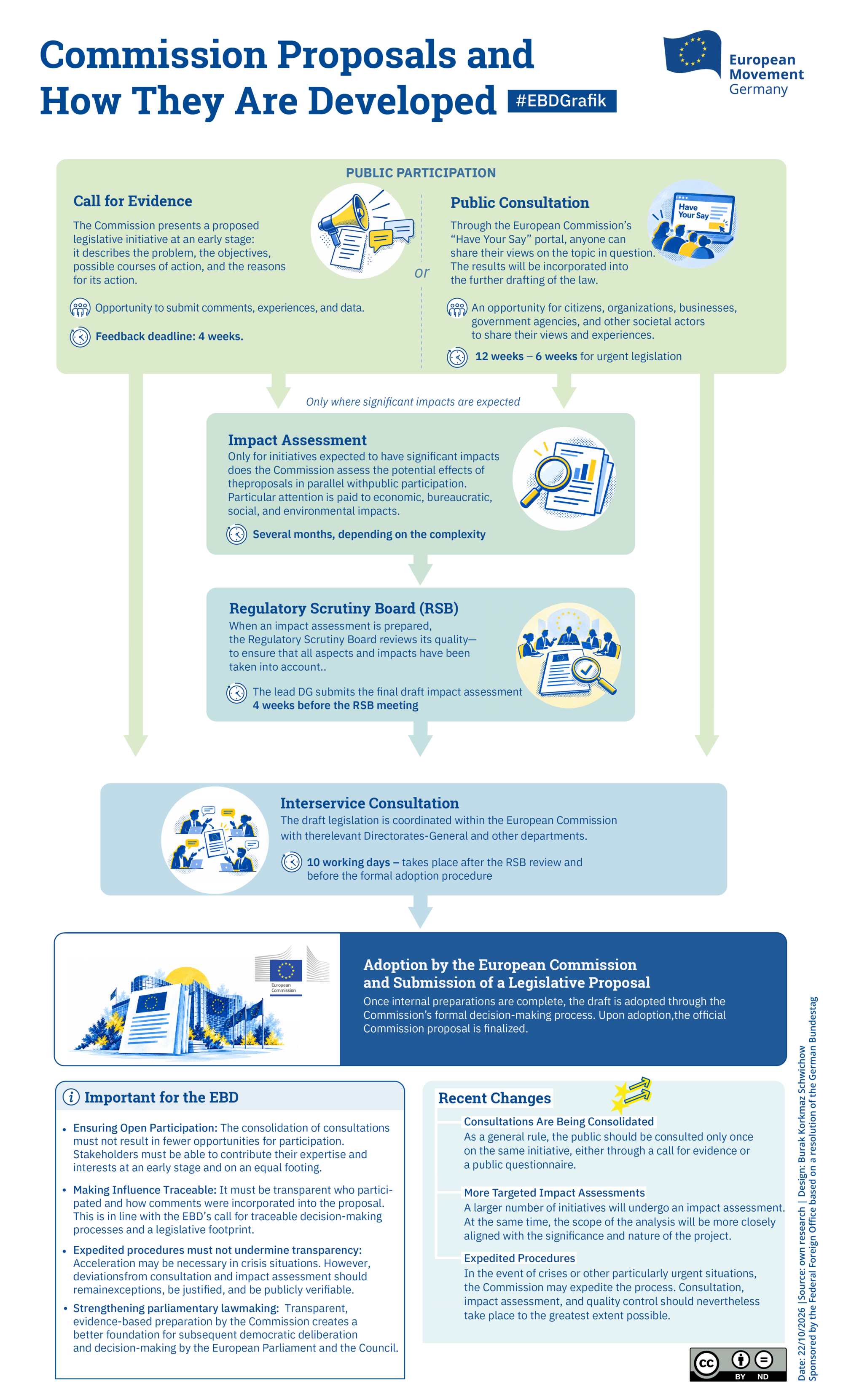
From the initial initiative to the official legislative proposal: How are European Commission proposals developed? Our EM Germany Graphic of the Month explains the different stages a legislative initiative goes through within the Commission and how European citizens can contribute to the process.
The graphic also highlights recent legislative changes that are particularly relevant to the EM Germany network. From EM Germany's perspective, early participation, transparent procedures and accountable decision-making are essential when preparing European legislation. | Download the graphic
EM Germany News
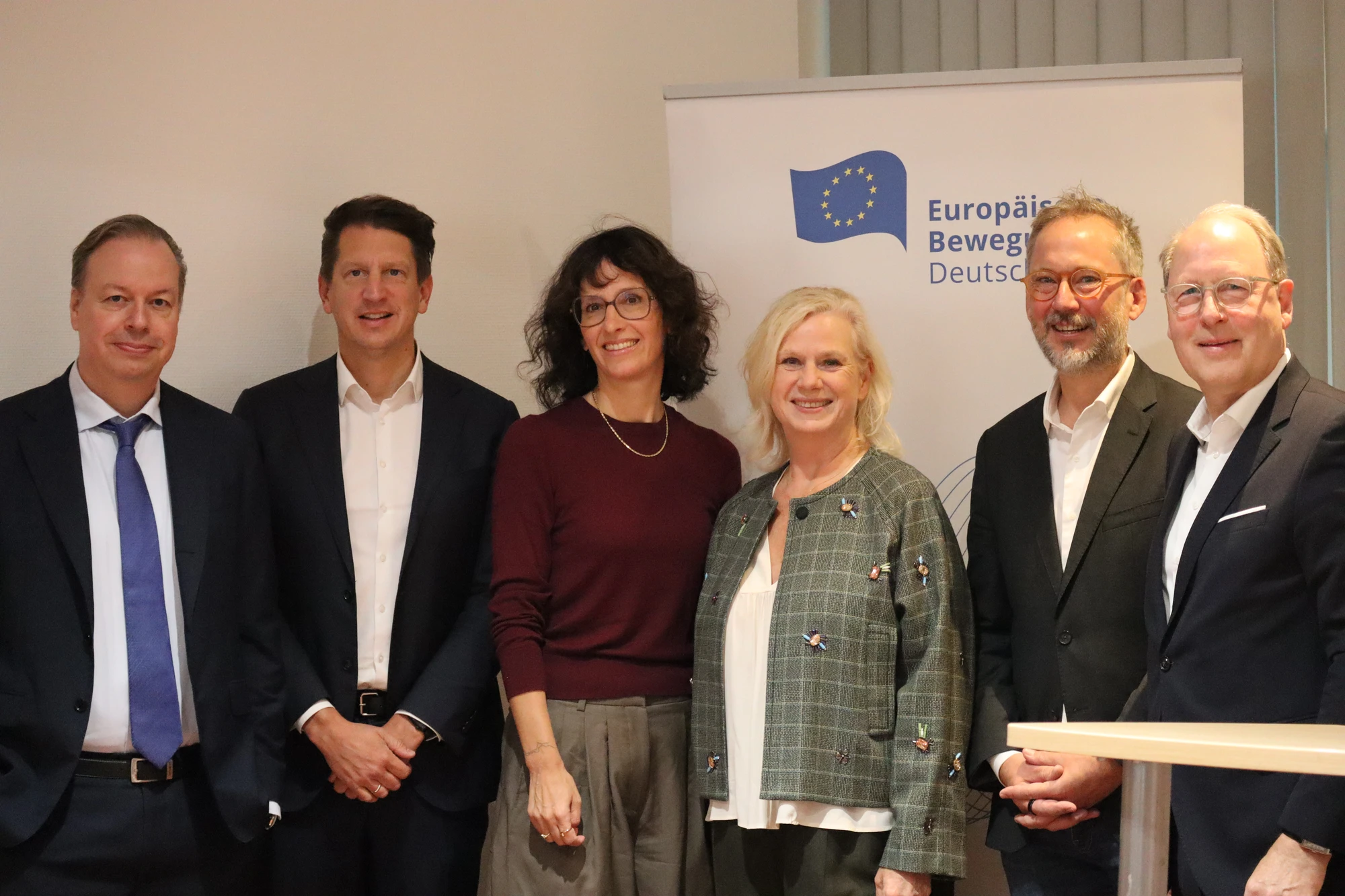
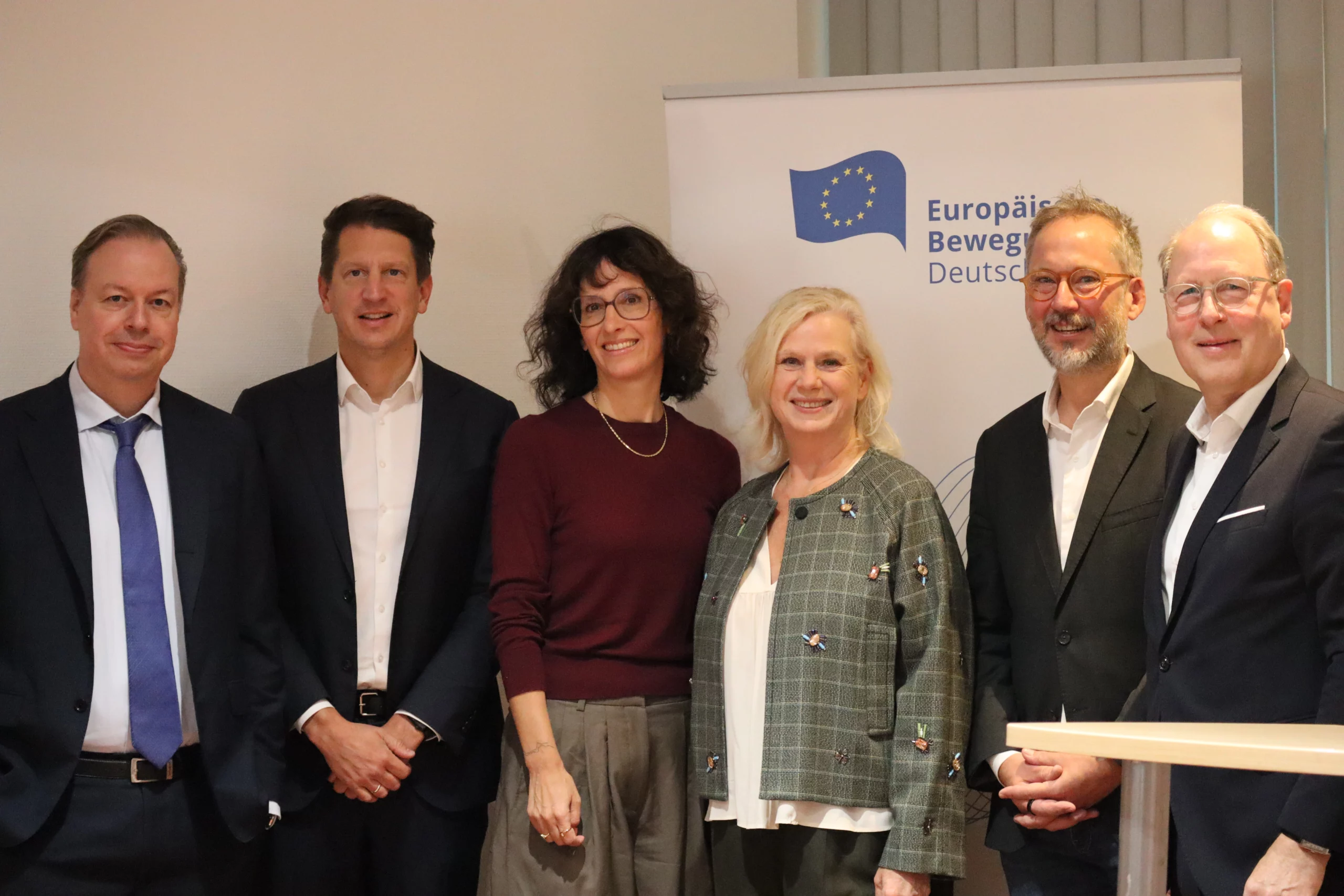
Europe Under Pressure to Act: What we can Take Away from the EU Summit
Many pending issues, lack of consensus: The European Council meeting on the 15 and 16 October 2026 in Brussels ended without an agreement on the EU budget, amid disagreements over energy prices and emissions trading, and with little progress on the topic of EU enlargement. What do the summit's outcomes mean for Germany and Europe? These topics were discussed by the EM Germany Network on 19 October at the European Council De-Briefing. The event was hosted in Berlin by EM Germany member organisations German Retail Federation (HDE) and Federation of German Wholesale, Foreign Trade and Services (BGA).
Following a welcome by Stefan Genth (HDE) and Antonin Finkelnburg (BGA), Ole Funke from the German Federal Chancellery presented the German government's assessment of the Council meeting. Discussions focused in particular on negotiations over the Multiannual Financial Framework (MFF) 2028–2034, EU competitiveness, reducing bureaucracy and high energy prices.
Barbara Gessler, Head of the European Commission Representation in Germany, addressed the issues of migration and so-called gold-plating in the implementation of EU legislation, among other topics. Prof. Dr. Funda Tekin, EBD Board Member and Director of the Institute for European Politics (IEP), discussed the slow progress of EU enlargement and the importance of the rule of law. The discussion was moderated by Bernd Hüttemann, Em Germany Secretary-General. | Read more (in German)
22 EM Germany Member Organisations Call for a Strong EU Budget
What worth does Europe have for us? This question lies at the heart of a joint appeal to the German government by 22 EM Germany member organisations. At EM Germany's initiative, organisations representing business, trade unions, youth, environment and other sectors of society are calling on Germany to adopt a more ambitious position in the negotiations on the Multiannual Financial Framework 2028–2034 (MFF).
The message is clear: If we expect Europe to deliver more security, competitiveness, climate protection and social cohesion, the financial resources must also be provided that are needed to achieve these goals. Rather than assessing the EU budget solely in terms of national contributions and returns, the European added value of joint investments must be the decisive factor. Germany, in particular, benefits from this.
The appeal also calls for Europe's political priorities to be reflected in the budget, EU funding to remain strictly conditional on the rule of law, and a timely agreement to prevent funding gaps from 2028 onwards. Through their joint appeal, the 22 member organisations urge the German government to take responsibility for an EU budget that meets Europe's shared challenges. | Read the joint appeal
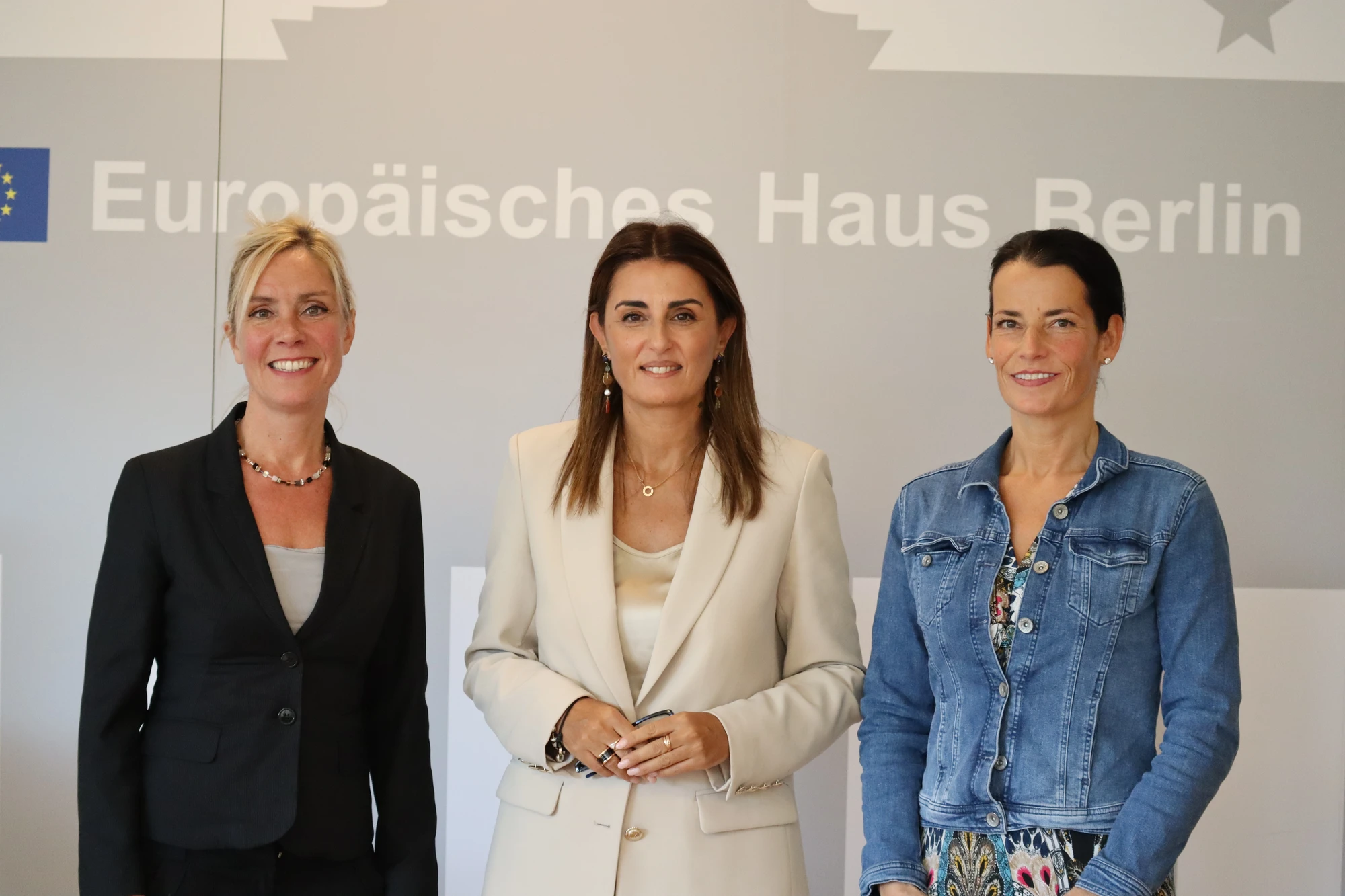
Trust in the European Administration | EBD Dialogue with the European Ombudswoman
How can the EU make decisions more quickly while remaining transparent, accessible and accountable? This question was at the heart of the discussion on 6 October 2026 between European Ombudswoman Teresa Anjinho, EM Germany President Dr Anna-Maija Mertens, representatives of EM Germany member organisations and institutional partners. EM Germany, together with the European Parliament Liaison Office in Germany, hosted the dialogue at the European House in Berlin. The discussion was moderated by Judit Hercegfalvi, Head of the Liaison Office.
Teresa Anjinho explained her role as a bridge between the EU institutions and the EU citizens, emphasising the importance of identifying and addressing shortcomings in European administration at an early stage and in a solution-oriented manner. The discussion covered access to EU documents, European Citizens’ Initiatives, the participation of societal actors and the challenges of digital transformation.
Dr Mertens stressed that the EU's capacity to act and democratic legitimacy are not mutually exclusive. Faster decision-making procedures must not come at the expense of transparency, accountability or participation. Instead, it is essential to involve societal forces at an early stage and ensure transparency about how their interests are reflected in the EU's decisions. | Read more here (in German)
European Support for Saxony-Anhalt
What are the consequences of the state election in Saxony-Anhalt for European policy work in the region? This question brought together representatives from politics and society at the state parliament in Magdeburg on 1 October 2026. The event was organised by the European Movement Saxony-Anhalt, with the support of EM Germany.
Following welcoming remarks by Anne-Marie Keding, then Vice-President of the State Parliament, and Thomas Rieke, Vice-President of the European Movement Saxony-Anhalt, Secretary-General Bernd Hüttemann of EM Germany addressed the implications of the election results for European policy. The subsequent discussion, featuring Dr Falko Grube MdL (SPD) and Olaf Meister MdL (Alliance 90/The Greens), among others, emphasized the role of Europe in the election campaign and the challenges facing the new legislative term.
One key takeaway: Commitment to work on European issues remains strong in Saxony-Anhalt. However, closer cooperation and stronger networks among active organisations from business, education, associations and other sectors of society are still needed. EM Germany and the European Movement Saxony-Anhalt aim to address this by making more targeted use of existing connections. EM Germany member organisations are also encouraged to contribute by engaging their regional networks and contacts to help strengthen European policy work at the local level long term. | Read the full event report (in German)
Keeping Brussels Connections Alive | Brussels Alumni Meeting 2026
What stays with you from your time in Brussels, even after your career has taken you elsewhere? Shared experiences, personal contacts and connections that extend far beyond the European capital. This was evident at the Brussels Alumni Meeting on 30 September 2026 at the Embassy of the Kingdom of Belgium in Berlin. Together with the Belgian Embassy and POLITICO, EM Germany invited former Brussels-based actors to reconnect and exchange views on European affairs. The Brussels Alumni Network now brings together more than 2,000 people.
H.E. Piet Heirbaut, Ambassador of the Kingdom of Belgium to Germany, opened the evening alongside EM Germany Secretary-General Bernd Hüttemann and Hans von der Burchard of POLITICO. The evening's special guest, Christoph Wolfrum, Director-General for European Affairs and Geoeconomics at the German Federal Foreign Office, provided insights into current European policy developments. Drawing on his personal experiences in Brussels, he highlighted how these perspectives continue to shape political work in Berlin.
Over Belgian specialities, former Brussels-based actors from politics, business, associations and other sectors took the opportunity to reconnect with old contacts, forge new connections and exchange views on current European policy issues. It is precisely this combination of shared experiences and professional exchange that defines the Brussels Alumni Network, fostering cooperation across institutions and professional fields. | Find out more (in German)
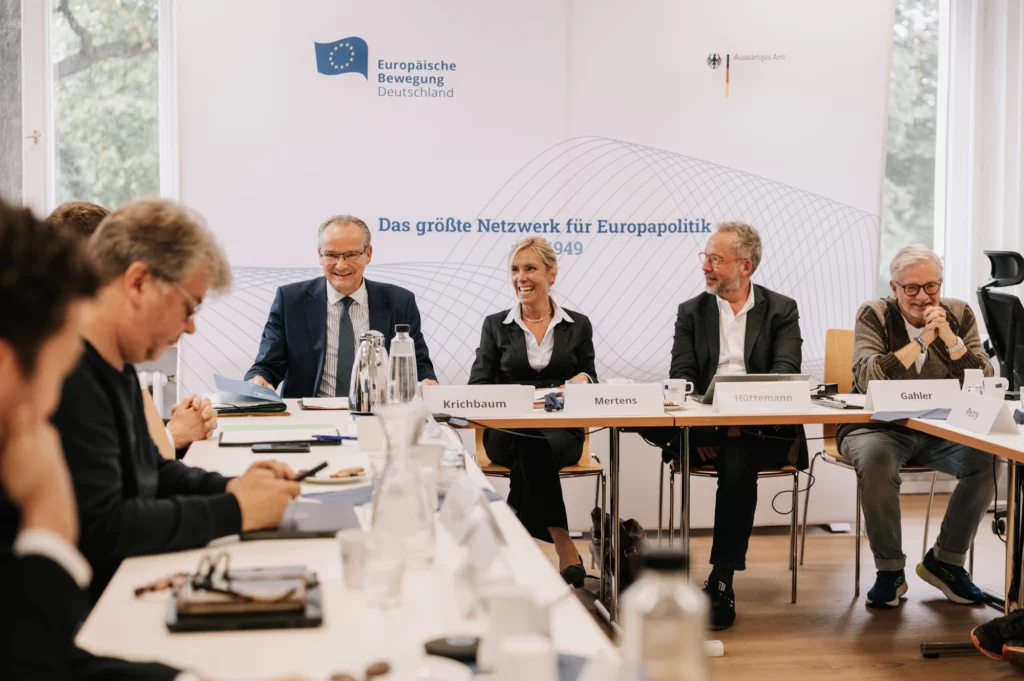
New EM Germany Board Begins Its Work
On 25 September 2026, the newly elected Board of EM Germany held its first meeting at the EM Germany Secretariat-General office in Berlin following the General Assembly. EM Germany President Dr Anna-Maija Mertens welcomed the Board members, including the newly elected representatives. A particular highlight was the exchange with Gunther Krichbaum MdB, Minister of State for Europe at the German Federal Foreign Office.
Together with Krichbaum, the Board members discussed the German government's European policy priorities, particularly the Multiannual Financial Framework (MFF) 2028–2034 (MFF), EU enlargement and necessary institutional reforms. These issues also reflect key priorities of the EM Germany Policy 2026/27, whose implementation was another focus of the Board's discussions.
The EM Germany network continues to grow: The Board approved the admission of five new member organisations: Bayer AG, Bundesverband Schausteller und Marktkaufleute, Deutsches Studierendenwerk, PariJus gGmbH and Twp Berlin. This brings EM Germany's membership to a total of 229 member organisations. | Read more (in German)
Upcoming Events
EM Germany De-Briefing AGRIFISH
28 October 2026 | What lies ahead for the Common Agricultural Policy after 2027, and what decisions are on the agenda for European fisheries policy? At the online EBD De-Briefing Agriculture and Fisheries Council (AGRIFISH), Dr Andreas Flach, Policy Officer for EU Coordination with a focus on agriculture at the German Federal Ministry of Agriculture, Food and Regional Identity (BMLEH), will provide the German government's perspective on the outcomes of the Council meeting on 26 and 27 October. The briefing will focus on the future of European agricultural policy, current agricultural trade issues and fishing opportunities in the Baltic Sea for 2027. | Further information (in German)
EM Germany De-Briefing ECOFIN & Eurogroup
11 November 2026 | What are the key outcomes of the Eurogroup and Economic and Financial Affairs Council (ECOFIN) meetings? At the online EM Germany De-Briefing, Ines Schlotter from the German Federal Ministry of Finance (BMF) will provide the German government's perspective on the meetings held on 9 and 10 November. In addition to economic and financial policy discussions, the briefing will also address European budgetary matters. | Further information (in German)
EP Rapporteur in Dialogue: Damian Boeselager on the Digital Euro
20 November 2026 | How will the digital euro transform European financial transactions, and what opportunities and challenges will it bring for businesses and consumers? These questions will be at the heart of the “EP Rapporteur in Dialogue” event on 20 November at the European House in Berlin.
Together with Damian Boeselager MEP, Sebastian Siepen from the European Central Bank (ECB), Stefan Genth, Director General of the German Retail Federation (HDE), and Dorothea Mohn, Head of the Financial Markets Team at the Federation of German Consumer Organisations (vzbv), will discuss the current state of the legislative process and prospects for the digital euro. The discussion will be moderated by Bernd Hüttemann, Secretary-General of EM Germany. | Further information (in German)
EM Germany De-Briefing General Affairs Council
23 November 2026 | The General Affairs Council (GAC) will meet on 19 November. At the online EM Germany De-Briefing, Sebastian Fischer, Deputy Director-General for EU Affairs and Coordination at the German Federal Foreign Office, will provide the German government's perspective on the outcomes of the latest meeting. The GAC addresses overarching European policy issues, including preparations for European Council meetings, EU enlargement and the Multiannual Financial Framework (MFF). | Further information (in German)
Check out former editions of our newsletter here.
Please sign up here if you would like to receive the newsletter.
Zur deutschen Version dieses Newsletters.