EBD Newsletter September 2026 | After the SOTEU: What Europe Needs to Be Capable of Action
Dear Readers,
How can Europe decide and act autonomously in an increasingly harsh world? This question was at the heart of the State of the European Union Address. Ursula von der Leyen outlined important answers: greater European sovereignty, a stronger security and economic policy, new partnerships, and further steps towards enlargement. From the perspective of the EM Germany, however, one crucial question remains unanswered: Anyone who wants to make Europe more capable of acting must also further develop its institutions and decision-making procedures. Our analysis of the "SOTEU" shows why enlargement, democracy and institutional reform belong together.
This is why we are following particularly closely the idea of a new “Congress of Europe.” For us as a European Movement, this term has a special historical significance: the Congress of The Hague in 1948 provided decisive impetus for European integration and for the emergence of the European Movement. A new European forum can also stimulate important debates today. What matters, however, is that participation generates political impact. With the European Citizens’ Consultations in 2018/19 and the Conference on the Future of Europe in 2021/22, many ideas and reform proposals have already been developed — yet key institutional consequences failed to materialise. Europe should therefore not start again from scratch.
Citizen participation, organised interests and the networking of democratic actors in civil society are all part of a vibrant European democracy. They complement representative democracy — they do not replace it. In the end, democratically legitimised parliaments and governments must assume responsibility, take decisions and implement reforms. For the EBD, more European participation, strong parliamentary democracy and pluralistic interest representation therefore go hand in hand.
This becomes particularly important with regard to enlargement. The European perspective for Ukraine, Moldova and the countries of South-Eastern Europe is fundamentally changing the European Union. An EU with more than 30 Member States needs decision-making procedures that are democratically legitimised and at the same time capable of action. For us, therefore, the following applies: enlargement and reform must be considered together. The fact that the European Council intends to address enlargement and reforms strategically in October is an important next step in this regard.
Also intriguing is the proposal to bind Canada more closely to the European Union through a new form of association. We need an open and outward-looking integration architecture. New partnerships with democratic states can strengthen Europe’s capacity to act on the global stage. What rights and obligations such a status could entail, and how it would differ from regular EU membership, must now be specified in concrete terms.
However, Europe’s capacity to act is not demonstrated only in major questions about the future. It is also reflected in whether jointly agreed European rules prove sustainable in everyday practice. For us, this includes, for example, a functioning Schengen area with protected external borders and generally open internal borders. It also includes better European law-making: with regard to so-called gold-plating, a critical review is needed of where Member States add unnecessary national complications to European requirements — without at the same time dismantling common standards of protection.
All these questions rest on a shared foundation: Europe can only be as strong as its democracy. This is why, with the Berlin Democracy Declaration, the EBD is also working on a contribution to the New Democratic Pact for Europe of the Council of Europe. At the same time, our EBD/YouGov business survey shows how closely democracy and economic stability are linked: 78 per cent of the business decision-makers surveyed regard democratic stability as a relevant precondition for economic success, and 81 per cent see companies as having a responsibility to contribute to the protection of democracy.
Democracy does not arise solely in European institutions or national parliaments. It is lived every day — in companies, trade unions, associations, clubs, youth organisations and many other parts of our society. A Europe capable of action therefore needs both: strong democratic institutions and a strong, pluralistic democratic society.
With European regards,
Yours sincerely,
Dr Anna-Maija Mertens
President of the European Movement Germany
#EBDGrafik of the month
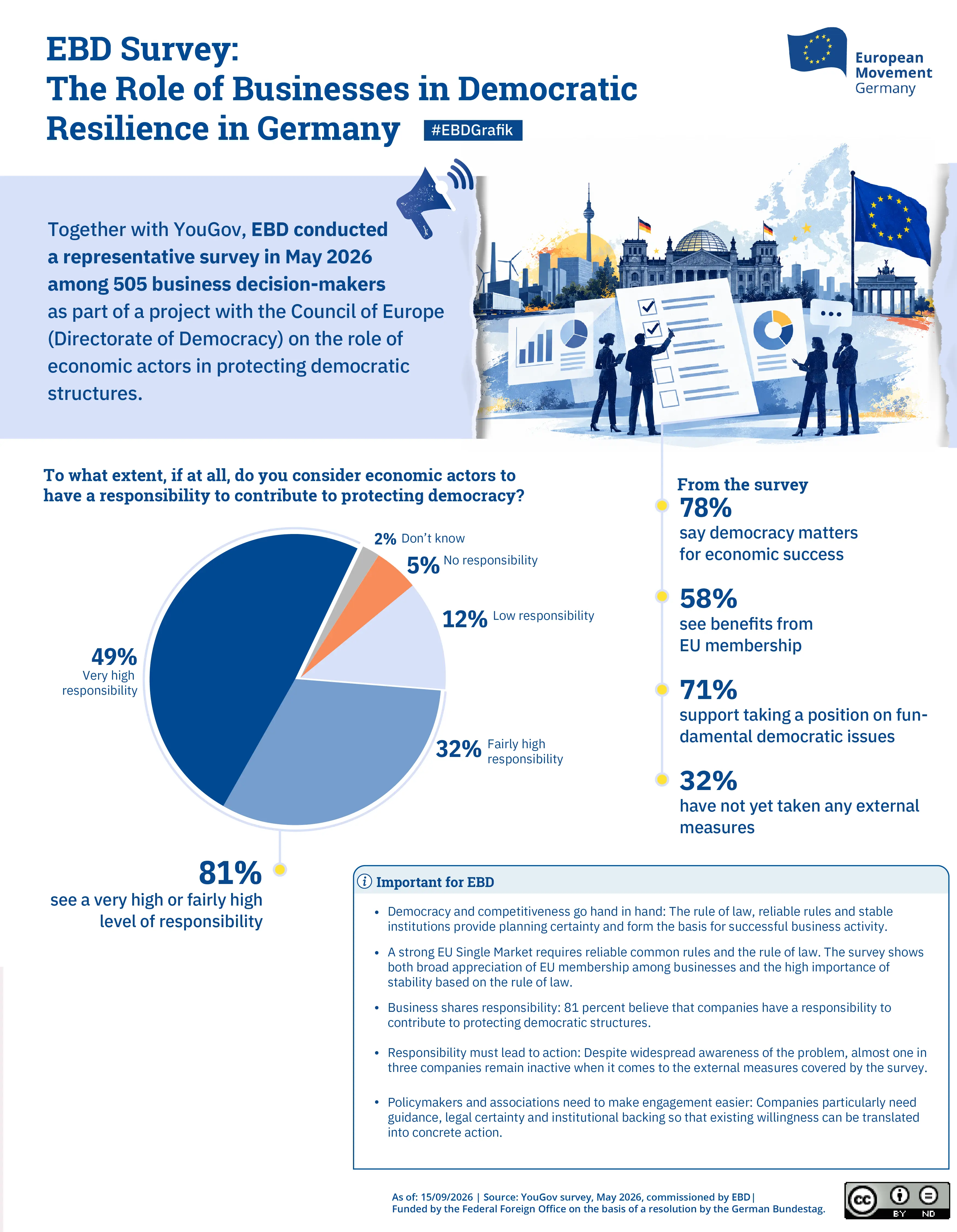
Our Chart of the Month delves deeper into this survey and clearly shows that a total of 81 percent of the companies surveyed feel a responsibility to protect democratic structures and society. | Download
EM Germany News
State of the European Union (SOTEU) Address 2026
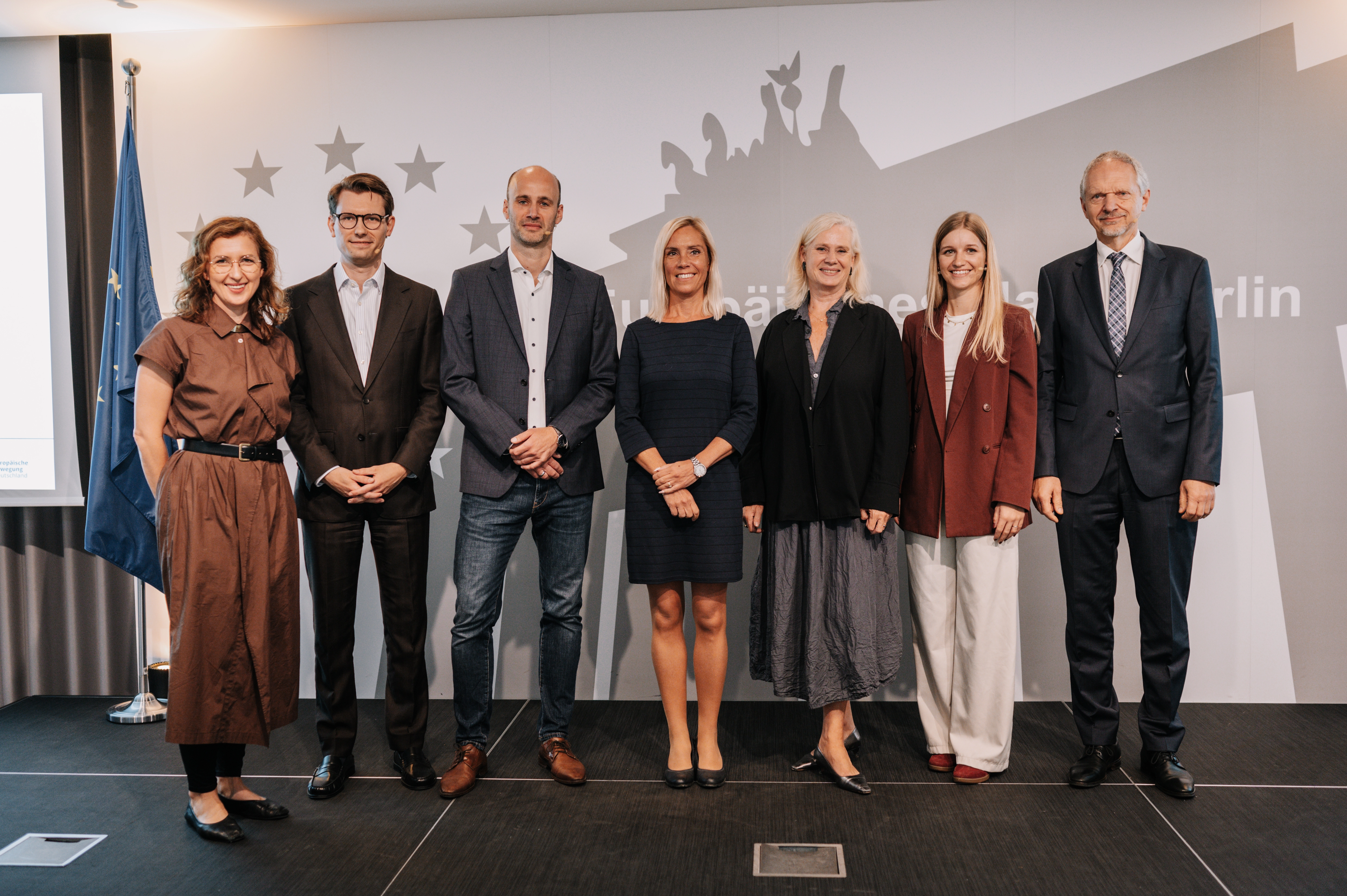
On September 16, 2026, more than 200 guests attended the State of the European Union address by European Commission President Ursula von der Leyen at the European House in Berlin. The event was hosted by the EBD in collaboration with the European Commission Representation in Germany, the European Parliament Liaison Office in Germany, and Table.Briefings. EBD President Dr. Anna-Maija Mertens provided context for the speech and subsequently engaged in a discussion with Lithuanian Ambassador H.E. Giedrius Puodžiūnas, Fabian Zacharias (Bitkom), and Isabel Rutkowski (Catholic Rural Youth Movement of Germany). Till Hoppe (Table.Media) moderated the discussion.
The EBD draws a mixed conclusion: The focus on European sovereignty and the ability to act is appropriately set. The EBD also welcomes the clear prospect of accession for Ukraine, Moldova, and the Western Balkan states. However, a concrete reform path is lacking for a future Union with more than 30 members. “Anyone who wants a strong Union must urgently reform its institutions and decision-making processes now,” emphasizes EBD President Dr. Anna-Maija Mertens.
Also noteworthy is von der Leyen’s proposal to bring Canada, as the first associate member, closer to the EU. It remains to be seen what rights and obligations such a status would entail. Regarding the Schengen Area, EBD Secretary-General Bernd Hüttemann calls on the Commission to take responsibility: It must prevent permanent internal border controls from becoming the norm. | Read more here
Between Uncertainty and Cautious Optimism
One day after the ECB Governing Council meeting, on September 11, 2026, the EBD, together with its member organization, the German Savings Banks and Giro Association (DSGV), hosted a debriefing session. Representing the ECB were Fédéric Holm-Hadulla, Senior Adviser, and Eva Taylor, Head of the Strategic Communications Section. Dr. Reinhold Rickes, Chief Economist of the DSGV, delivered the opening remarks.
The ECB Governing Council had raised key interest rates by 25 basis points; the deposit rate now stands at 2.50 percent. This move was driven in particular by the sharp rise in energy prices. The key factor for future monetary policy will be whether this price shock also affects wages, prices, and inflation expectations. Given the high level of uncertainty, the ECB is maintaining a data-dependent approach and is not preempting further interest rate moves.
The meeting also discussed the role of the euro in an increasingly multipolar world and the contribution that the digital euro could make to a sustainable European payments system. Despite the energy price shock and inflationary pressures, the overall mood remained cautiously optimistic: robust economic growth and a resilient labor market provide cause for confidence. | Read the follow-up report
EBD Adopts the Berlin Democracy Declaration
With the Berlin Democracy Declaration 2026, the EBD is contributing its recommendations to the Council of Europe’s consultation on the New Democratic Pact for Europe and, at the same time, concluding its 2025/26 EBD-Council of Europe project. The declaration, adopted by the EBD Executive Board, links economic capacity for action with the rule of law, social cohesion, and democratic self-organization.
A key focus is the economic dimension of democratic resilience. A representative YouGov survey commissioned by the EBD shows that 78 percent of the economic decision-makers surveyed view democratic stability as relevant to their company’s economic success. At the same time, 81 percent believe companies have a responsibility to protect democratic structures.
Based on these findings, the Berlin Democracy Declaration calls for the inclusion of economic factors. The surveys make it clear that a strong democracy is a prerequisite for sustained economic growth and should be incorporated into the Council of Europe’s consultation process. | Read more
Germany’s Political Landscape in Flux: What Are the Consequences for Europe?
In an interview with Radio France Internationale (RFI), EBD Secretary-General Bernd Hüttemann contextualizes the AfD’s electoral success in the state election in Saxony-Anhalt within the broader political developments in Germany and Europe. He highlights the particular resilience of Germany’s federal and pluralistic political system, but at the same time warns against democratic parties being overtaken by extremist forces.
With regard to France and other European countries, Hüttemann emphasizes that the rise of nationalist forces should not be met with purely national responses. Especially in light of shared challenges such as Russia’s war of aggression against Ukraine and relations with the U.S. and China, he argues, European responses and a united, effective EU are needed. The interview thus ties in with the EBD’s call to strengthen democratic forces and ensure Europe’s capacity to act through joint European action. | Click here for the interview
The Four Focus Areas for the EBD Policy 2026/27
With the EBD Policy 2026/27, which was adopted at the General Assembly, our network articulates its shared positions on European policy. The EBD member organizations contribute their diverse perspectives to this process and agree on common political ground. The EBD Policy thus forms the substantive foundation of our work.
For 2026/27, the General Assembly adopted four focus areas: ensuring Europe’s capacity for democratic action, strengthening Europe’s foreign policy responsibilities, strengthening European education and social participation, and further developing the single market in a way that is liberal, sustainable, social, and democratic.
This structure is now also reflected on our website, where you’ll find an overview of the focus areas as well as the EBD’s political positions and demands. At the same time, we are working on the new EBD umbrella strategies for 2026/27. These strategies are intended to more closely integrate EBD policy, member engagement, public affairs, projects, and stakeholder networks in particularly relevant areas and will also be given greater visibility in the EBD newsletter going forward. | Discover EBD Policy 2026/27
Upcoming Events
From Brussels to Berlin: The Brussels Alumni Network Meets
September 30, 2026 | The “Brussels Alumni in Berlin” event series enters its next phase: Together with the Embassy of the Kingdom of Belgium and POLITICO, the EBD invites you to a special edition at the Belgian Embassy. H.E. Piet Heirbaut, Ambassador of the Kingdom of Belgium to Germany, EBD Secretary General Bernd Hüttemann, and the POLITICO editorial team welcome those with experience in Brussels for personal exchanges and networking.
The Brussels Alumni Network now connects more than 2,000 people who have spent time in Brussels for professional or personal reasons, as well as alumni of the College of Europe. Anyone with experience in Brussels can register until September 25, 2026. | Read more here
EBD Dialogue with the European Ombudswoman
October 6, 2026 | Exchange with the European Ombudswoman: Teresa Anjinho will be a guest at the EBD Dialogue at the European House and will engage in conversation with EBD member organizations. The event offers an opportunity to learn more about the work of the European Ombudswoman and to contribute your own questions directly to the discussion.
Following an opening remarks by Teresa Anjinho, EBD President Dr. Anna-Maija Mertens will provide an initial overview. Afterward, both will engage in a discussion with the participating stakeholders. The EBD Dialogue will take place from 11:00 a.m. to 12:00 p.m. in English and in cooperation with the European Parliament’s Liaison Office in Germany. | Read more here
EBD De-Briefing on the European Council
October 19, 2026 | The European Council will meet in Brussels on October 15 and 16. Among the topics the heads of state and government will address this fall are European defense and security, the next Multiannual Financial Framework, and the EU’s competitiveness.
Immediately following the summit, Ole Funke, Head of Group 52 at the Federal Chancellery, will analyze the summit’s outcomes from the German government’s perspective at the EBD De-Briefing. The debriefing begins at 8:30 a.m. at our member organization, the German Retail Association (HDE), in the “Retail – Services – Tourism” Association Building in Berlin. | Read more here
Check out former editions of our newsletter here.
Please sign up here if you would like to receive the newsletter (in German).
Zur deutschen Version dieses Newsletters.