EBD Newsletter June 2026 | Capable of Acting, Reforming and Enlarging
Dear readers,
an “associated EU membership” for Ukraine? The Federal Chancellor’s proposal marks an important shift in perspective: enlargement is finally being understood more clearly as a geopolitical and security-policy necessity. It is good that new momentum is entering the debate. What remains crucial, however, is this: every interim step must strengthen the full accession perspective — and be linked to the rule of law, democracy and the European Union’s capacity for reform. Europe still faces major tasks, especially when it comes to internal reforms.
This is precisely where the European policy focus of the coming weeks lies. The upcoming European Council will have to show whether the EU is thinking enlargement, financing, security and its own capacity to act together. This also includes making the European Union itself more capable of reform: more majority voting, clear procedures, parliamentary oversight and a budget that can actually underpin political promises. Together with the Federal Chancellery, we will once again inform you about the results afterwards as part of our EBD De-Briefing and discuss whether Europe has taken the necessary step forward.
At the same time, with the reformed Common European Asylum System entering into force on 12 June, Schengen is also moving back into focus. Protection of the external borders, procedures based on the rule of law and open internal borders must not be played off against one another. For cross-border citizens, commuters, businesses and regions, freedom of movement is not an abstract ideal, but the lived reality of the single market. Those who make internal border controls the norm damage trust and everyday life in Europe. That is why the current controls must be lifted again as quickly as possible. It is good that the European Commission is now also making this point clearly.
As a network, we will address these issues in our usual way. At our 2026 Members’ Assembly on 22 June, we will discuss the new EBD policy and the focus topics for 2026/27. At the heart of this is a central question: How do we secure Europe’s capacity to act at a time of growing geopolitical, economic and societal challenges? To this end, the Executive Board proposes four closely interconnected priorities: strengthening Europe’s democratic capacity to act, expanding Europe’s foreign-policy responsibility, promoting European education and societal participation, and further developing the single market in a liberal, sustainable, social and democratic way.
I am particularly looking forward to the discussions at our Members’ Assembly. Europe needs not only greater capacity to act, but also greater ambition. Germany, as the largest Member State, bears a special responsibility for ensuring that the European Union remains capable of reform, enlargement and international action. EBD will continue to make a constructive contribution to this — as a network, as a platform for dialogue and as a voice for a strong Europe in Germany.
Just how timely these debates are was recently demonstrated by our successful EBD De-Briefing on the General Affairs Council, held
together with the Federal Foreign Office. Enlargement, the rule of law, competitiveness, security and the next Multiannual Financial Framework belong together. That is what matters to us as a network — and that is what matters in Europe today more than ever.
With European regards,
Yours,
Dr Anna-Maija Mertens • President
EM Germany News
EP Rapporteur in Conversation: MEP Gaby Bischoff on the Reform of the Regulation on the Coordination of Social Security Systems.
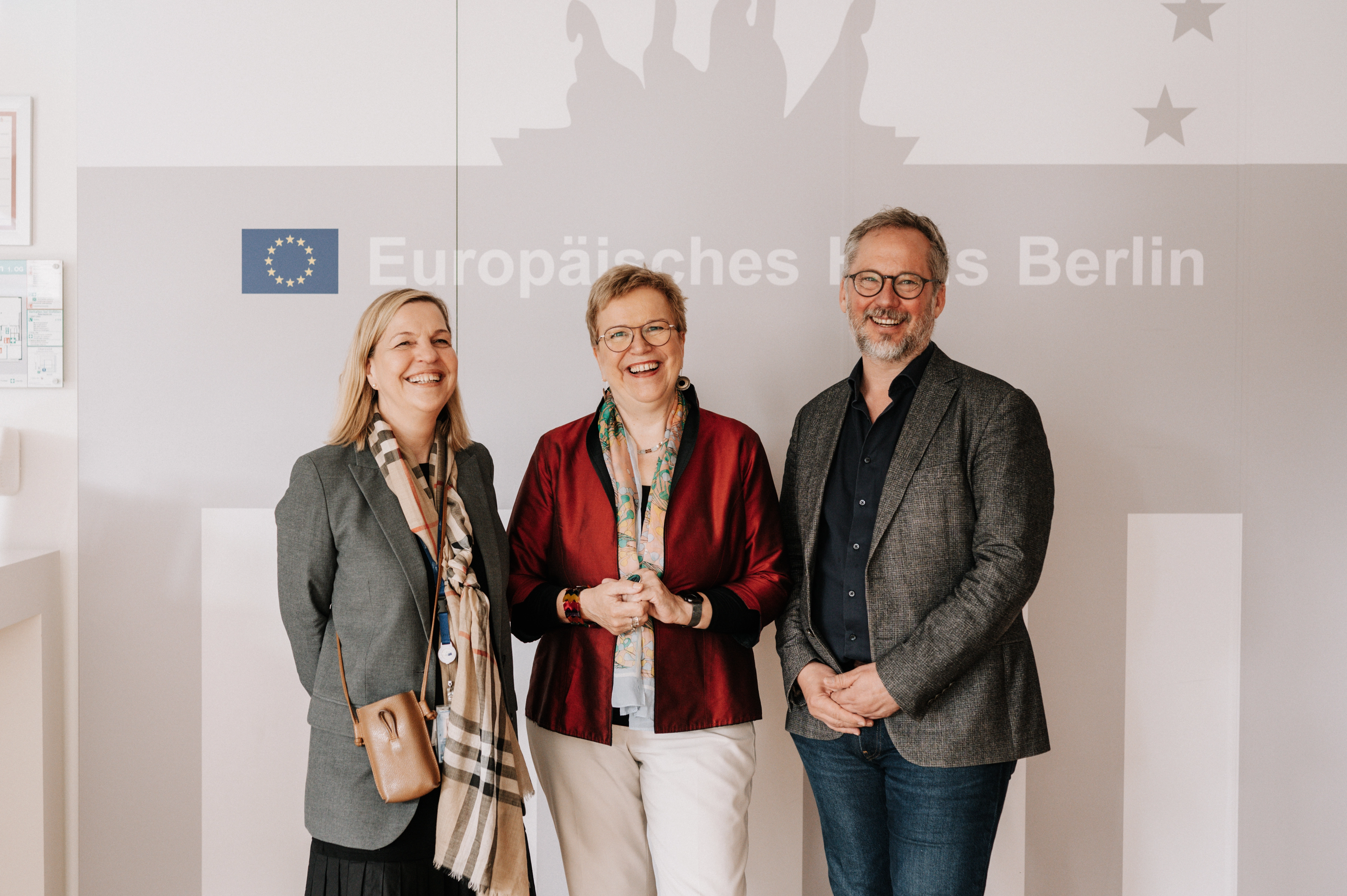
In April 2026, after nearly ten years, the Parliament, the Council, and the Commission reached a provisional agreement on a reform of the Regulation on the Coordination of Social Security Systems. The goal is to adapt the Regulation 883 to new challenges such as changing forms of employment and advancing digitalization. The reform aims to ensure greater transparency and facilitate the application of the rules. In doing so, it seeks to guarantee fair regulations as well as protection and legal certainty for those affected.
On June 5, Gaby Bischoff, MEP, spoke at the Europäisches Haus in Berlin about the significance of this agreement for the approximately 14 million people who live and work across borders in the EU. As the European Parliament’s rapporteur, she explained the key elements of the reform, provided insights into the negotiations, and answered questions from the audience. The subsequent discussion focused, among other things, on practical implementation, the effects of varying degrees of digitalization across Europe, and planned exemptions. It became clear that effective European coordination of social security systems is a key prerequisite for the free movement of workers within the European Union. | Read more here (in German)
Full House at the EBD Brüssel-Alumni Stammtisch Special

Brussels may be a thing of the past for many alumni—but the topics and connections are not. Europe, exchange, and new perspectives were the focus of the Brussels Alumni Get-Together Special on June 4, 2026. Organized in collaboration with POLITICO, this special edition of the networking event brought together numerous alumni from Brussels as well as graduates of the College of Europe. The lively atmosphere provided space for conversations, new connections, and discussions about current developments in Brussels and Europe. A special highlight of the evening was the visit from Sergey Lagodinsky, MEP. We thank all participants for their keen interest and the great atmosphere.
A quick preview: The EM Germany is also planning a larger alumni networking event in September 2026 in cooperation with the Belgian Embassy. Are you a Brussels alum and don’t want to miss any more events? Then please sign up for our Brussels alumni mailing list.
Premiere: The First EBD De-Briefing on the General Affairs Council
In the EBD De-Briefing on the General Affairs Council (GAC) on May 27, 2026, Anja Wallau (Federal Foreign Office) provided an overview of the outcomes of the Council’s most recent deliberations. The GAC coordinates the work of the various Council configurations, prepares European Council meetings, and addresses a range of cross-sectoral policy areas, including EU enlargement and the long-term budget (MFF).
The De-Briefing focused on preparations for the June meeting of the European Council and the current discussions on the Multiannual Financial Framework (MFF) for 2028–2034. In addition, relations between the EU and the United Kingdom, as well as progress and challenges in the EU enlargement process, were discussed. As part of the rule of law dialogue, France, Italy, Croatia, and Latvia provided updates on country-specific developments. Hungary also provided a separate update on the current status of the ongoing Article 7 procedure regarding the state of the rule of law in the country. | Read more here (in German)
Between Trade Partnerships and Security of Supply: Challenges Facing Agriculture
The diversification of trade relations and securing the supply of fertilizers were among the key topics discussed at the EBD De-Briefing AGRIFISH on May 28, 2026. Dr. Andreas Flach (Federal Ministry of Agriculture, Food and Regional Identity) provided an overview of the outcomes of the Agriculture and Fisheries Council meeting.
The focus was on the diversification of trade relations with third countries and the question of how European farmers can be supported in international competition. Another key focus was the European Commission’s plans to strengthen the supply of fertilizers in the EU. In this context, the proposed legislative package (Fertiliser Action Plan) was discussed. In addition, Dr. Flach explained the significance of the upcoming Irish Council Presidency for current agricultural policy challenges. | Read more here (in German)
European Cultural Heritage Brings Regions and People Together
On May 22, 2026, EM Germany Secretary General Bernd Hüttemann delivered a welcoming address at a reception hosted by the City of Paderborn to mark the awarding of the European Heritage Label. As a native of Paderborn, this award held special personal significance for him as well. Under the title “Stadt. Mensch. Fluss - Die Pader für Europa,” Paderborn was awarded the European Heritage Label for its unique urban river landscape.
The European Movement Germany e.V. warmly congratulates the City of Paderborn on this significant award. The afternoon also provided valuable insights for discussions on European remembrance culture, sustainable urban development, and the importance of cultural sites for European integration. | Learn more (in German)
Call for Nominations: Women of Europe Awards 2026
The European Movement International (EMI) is calling for nominations for the 2026 Women of Europe Awards. The awards honor women who have demonstrated exceptional commitment to Europe in the six categories: Woman in Power, Woman in Action, Woman in Business, Young Woman of Europe, Woman in Media, and Woman in STEM. For the “Woman in Action” and “Woman in STEM” categories, the European Movement Germany plans to nominate the winners of the Preis Frauen Europas 2026, Ina Rumiantseva and Prof. Dr. Gabriele Abels.
We invite our member organizations to submit proposals for additional candidates and to actively help shape the German nominations for the European award. Proposals must be submitted or endorsed by EM Germany member organizations. The EM Germany is accepting submissions until June 18, 2026, at pfe@netzwerk-ebd.de. | Further information
Upcoming Events
June 22, 2026 | EBD De-Briefing European Council
Just ahead of the EM Germany General Assembly, the EM Germany will review the outcomes of the European Council meeting held on June 18 and 19, 2026. Together with Ole Funke (Federal Chancellery), the key decisions of the summit and current developments in European policy will be discussed at the House of Agriculture and Food. | Further information (in German)
June 22, 2026 | EM Germany General Assembly 2026
The General Assembly of the European Movement Germany will take place on June 22, 2026, at the Haus der Land- und Ernährungswirtschaft in Berlin. Once a year, the member organizations of the EM Germany come together to discuss European policy priorities and the strategic development of the network. This year’s agenda includes, among other items, the adoption of the EBD Policy 2026/27 and the election of the EM Germany Executive Board. The resolutions and elections of the General Assembly will shape the network’s substantive and organizational work in the coming years. | Further information (in German)
July 1, 2026 | EBD De-Briefing EPSCO
On July 1, 2026, the EM Germany will host a digital debriefing on the outcomes of the meeting of the Employment, Social Policy, Health, and Consumer Affairs Council (EPSCO). Johanna Wöran (Federal Ministry for Education, Family Affairs, Senior Citizens, Women and Youth) and Alexandra Brzezinski (Federal Ministry of Labour and Social Affairs) will provide an overview of the results of the discussions from the perspective of the Federal Government. | Further information (in German)
July 6, 2026 | EBD Briefing on the Irish Presidency of the Council of the European Union
What are the key focuses of Ireland’s program for the 2026 EU Presidency, and which priorities are particularly relevant from a German perspective? At the EBD Briefing on the Irish EU Council Presidency on July 6, 2026, at the Europäisches Haus in Berlin, Irish Ambassador H.E. Maeve Collins will present the focus areas and priorities of the presidency. Christoph Wolfrum (Federal Foreign Office) and Gisela Hohensee (Federal Ministry for Economic Affairs and Energy) will shed light on their significance from the perspective of the German government. | Further information will follow soon on our website (in German)
Check out former editions of our newsletter here.
Please sign up here if you would like to receive the newsletter (in German).
Zur deutschen Version dieses Newsletters.